Canaan was the name of a large and prosperous ancient country (at times independent, at others a tributary to Egypt) located in the Levant region of present-day Lebanon, Syria, Jordan, and Israel. It was also known as Phoenicia. The origin of the name 'Canaan' comes from various ancient texts and there is no scholarly consensus on precisely where the name originated nor what it meant.
According to the Bible, the land was named after a man called Canaan, the grandson of Noah (Genesis 10). Other theories cite 'Canaan' as derived from the Hurrian language for 'purple' and, as the Greeks knew the Canaanites as 'Phoenicians' (Greek for `purple') and as the Phoenicians worked in purple dye and so were called by the Greeks 'purple people', this explanation is the most probable. The theory has also been advanced that the name comes from the Hebrew root-verb kana which denotes order from chaos, a blending, or synchronous existence. Scholars J. Maxwell Miller and John H. Hayes claim no definitive meaning for the name citing ancient sources which used it simply as a place name:
The name 'Canaan' appears in various ancient texts from Egypt to Mesopotamia. In the Egyptian texts, Canaan seems to have been used as a designation for Egypt's Asiatic province. In the Bible, Canaan could refer to the whole of Palestine west of Jordan, the ideal inheritance of the Hebrews; but it could also refer to more restricted areas, especially the coastland of Palestine. Correspondingly, the biblical writers occasionally refer to the whole indigenous population of Palestine as `Canaanites' (thus interchangeably with 'Amorites'). On other occasions, they seem to distinguish the Canaanites and Amorites from other groups among the occupants of Palestine. (38)
The earliest habitation in the region was around the city of Jericho in the Paleolithic Age and this early rural community would then develop into the city which is the oldest urban center in the region (and, arguably, the world). Other cities developed during the Early Bronze Age but were abandoned, probably because of overpopulation, and the people returned to an agrarian lifestyle for a number of years. Cities again grew up during the Middle Bronze Age which saw the development of trade with other civilizations and, most notably, Egypt. Canaan (also referred to as Phoenicia at this time) continued to prosper until c. 1250 - c. 1150 BCE during the so-called Bronze Age Collapse. The biblical books of Joshua and Numbers attribute the destruction of Canaan to the Hebrew general Joshua and his conquest but this claim has been challenged by modern-day scholars.
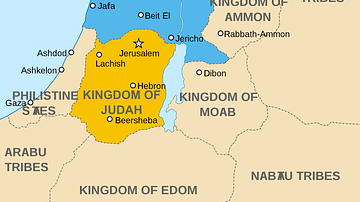
Following the upheaval of c. 1250 - c. 1150 BCE, however, the Hebrews (Israelites), to whom Joshua is said to have given the land, populated the region and established the kingdoms of Israel and Judah. These kingdoms lasted until the region was conquered in succession by the Assyrians, Babylonians, Persians, Alexander the Great, the Seleucids, and the Roman Empire.
Culture & Religion
The indigenous people of the land of Canaan were never a unified ethnic group nor did they worship the same gods in the same way. The term 'Canaanites' is used to refer to people who lived in the land of Canaan but it is unknown whether these people all shared a common language or worldview. The Phoenicians, for example, were Canaanites but not all Canaanites were Phoenicians.
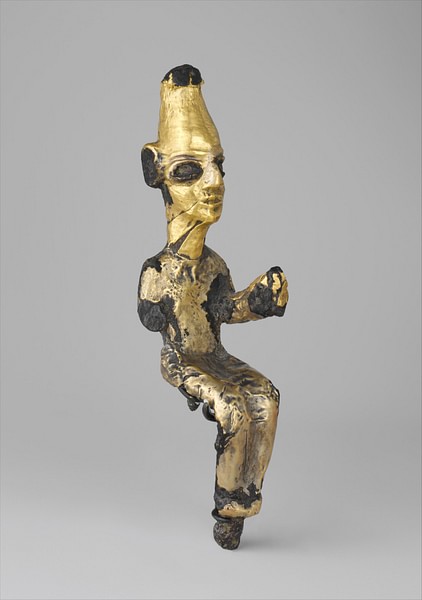
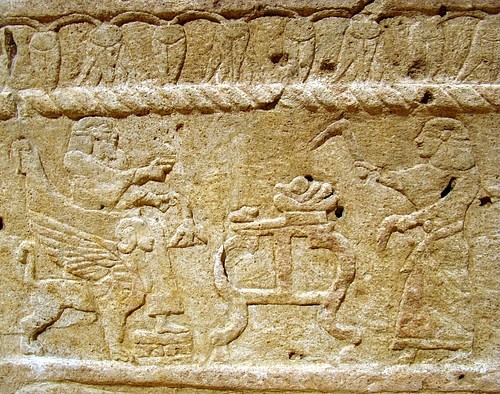
In religion, they worshipped many gods but, chief among them, the god El, the goddess Ashera (associated with Astarte) and her consort Baal, and Sumerian deities such as Utu-Shamash. Baal and Ashera are both considered initially vegetative/fertility deities who then took on more impressive attributes ascribed to Sumerian gods such as Enlil and Ninlil or Enki and Ninhursag. Other deities worshipped included a minor god named Yahweh who, according to recent scholarship, may have been the Canaanite god of metallurgy. Religious rites included human sacrifice (especially child sacrifice) in the understanding that the gods gave only the best to the people and so they should reciprocate by offering their best to the gods.
Women could and did serve as priestesses, could own land, enter into contracts and initiate divorce, all of which mirrored the cultural values of Mesopotamia. Fertility cults were numerous and bread and grain offerings were made to Ashera and her various regional avatars for increased fertility and healthy children. Human sacrifice does not seem to have played any part in the fertility cults and, further, it is unknown under what conditions a community would sacrifice one of their own.
There is no record of any king ruling a unified nation but only of men governing their own city-state and however much land around it they could hold. Depending on the strength of a city's ruler, and that city's resources, a community would prosper or fail. By the 2nd millennium BCE, for example, Byblos was the great exporter of cedar from Mount Lebanon and of papyrus to Egypt and other nations and was able to thrive because of an efficient government administration and ample resources.
Byblos, in fact, is probably the most famous of the Canaanite cities even if one has never heard of it. The name of the Bible comes from the Greek word byblos for 'Book', a reference to the city which supplied the surrounding nations with papyrus. Tyre was another great industrial center producing highly sought-after garments colored by the purple dye of Murex shells and the city of Sidon, also engaged in similar trade, was a great center of learning. The rivalry between Tyre and Sidon ensured high-quality products from both until Tyre eventually monopolized the textile business.
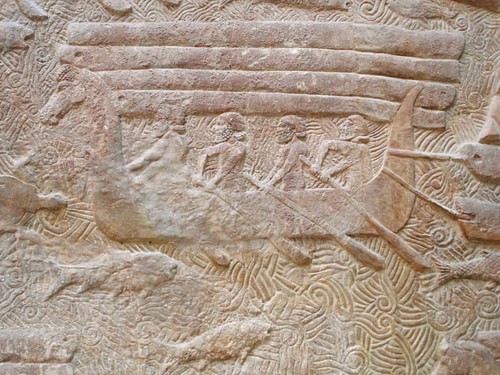
The region prospered through trade because of its location. It was the terminus, at Gaza, for the Incense Routes which wound up from the Kingdom of Saba in Arabia to then divide into diverse courses upwards throughout Mesopotamia and down through Egypt. It was also a nexus of trade between Mesopotamia, Egypt, and Libya. The Canaanite-Phoenicians were expert shipwrights and seamen and participated in trade directly, sharing their cultural values with other nationalities and importing other's values back to their own land.
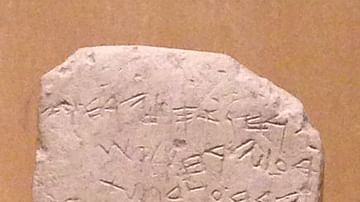
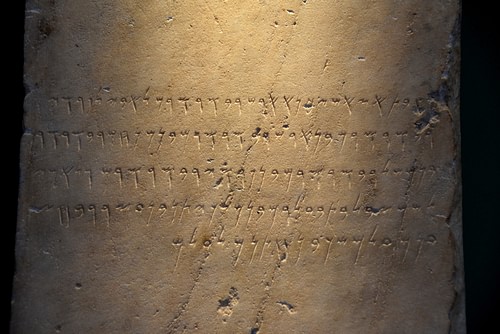
The Canaanite-Phoenicians developed the first alphabetic writing system, further developed mathematical principles from Mesopotamia, were renowned in the ancient world for their skill in shipbuilding and navigating the seas, and have also been cited as the early source or inspiration for the mythology of the Greek gods. The alphabet, however, is considered their greatest achievement, as noted by scholar Marc van de Mieroop:
The role of the Phoenicians in the spread of the alphabet is their most renowned accomplishment. Having preserved the use of the script in the Dark Age after 1200, the Phoenicians inspired all the alphabetic writing systems of their neighbors. In the Near East, the Hebrew and Aramaic scripts derived from the Phoenician. Of major importance to Europe was the adoption of the Phoenician alphabet by the Greeks, either directly from Phoenicians or through intermediaries in Syria or Anatolia. The classical sources were clear about this debt: the Greeks called their letters Phoenician. (222)
The Canaanite-Phoenicians sailed across the sea as far away as Spain and as far north as modern-day Cornwall, England, and their cities grew, owing to their prosperous trade, into places of splendor and wealth. All of this came later, however, following their involvement in trade with other nations. In the beginning, the people of the land were nomads who most likely migrated to the region from Mesopotamia.
Early History
Human habitation was established in the region before 10,000 BCE, but the people led a nomadic existence with only seasonal settlements (such as the site of the later city of Jericho). During the Early Bronze Age (c. 3500 - c. 2000 BCE), however, permanent settlements were founded and the practice of animal husbandry, established earlier, was developed further. The people were primarily hunter-gatherers as the land proved largely inhospitable for agriculture. The Larousse Encyclopedia notes how Canaan was never favored by nature for the cultivation of crops:
The zone of the high hills between the Jordan and the coastal plain was dry and infertile. Many waves of people had, however, succeeded each other here. The hazards and uncertainties of growing crops explain why nomadism always prevailed in Canaan [at an early date]. (81)
These early people have been designated proto-Canaanites by modern-day scholars because they had not yet established an identifiable culture. They worked in stone but built no structures and had a religious belief system but what it consisted of is unknown. They developed trade with other nations, however, prior to 2000 BCE and the region was considered important enough to be absorbed into the Akkadian Empire by Sargon the Great (r. 2334-2279 BCE) around 2300 BCE.
During this time, urban centers arose and trade either increased or was initiated with other nations. The primary commodity seems to have been ceramics and assorted pottery. After the fall of Akkad to the Gutians, Elamites, and Amorites in c. 2083 BCE, this commerce stalled and the cities were abandoned. The people seem to have returned to a nomadic, agrarian, lifestyle for reasons which are unclear but, possibly, due to overuse of the resources around the cities and overpopulation.
Middle Bronze Age
During the Middle Bronze Age (c. 2000 - c. 1550 BCE), the people returned to city-building. Urbanization and trade flourished and an early version of the Phoenician alphabet was developed which would have a significant impact on other nations of the time and later history. At this time, however, cuneiform was still the written language of trade in the Near East and it has been established that Canaan developed especially strong contacts with the cities of Mesopotamia through trade agreements. Miller and Hayes note:
In terms of basic cultural patterns – language, literature, mythological and theological perspectives, and the like – there seems to have been a closer kinship with Mesopotamia than with Egypt. The closer geographical proximity of Egypt, on the other hand, meant that Egyptian influence, both political and cultural, was also a fairly constant feature. (33)
Trade had first been established between the Canaanite port city of Byblos and Egypt in c. 4000 BCE and, by 2000 BCE, Egypt was the region's most important business partner. Burial rituals in Canaan during the Middle Bronze Age mirrored both Egyptian burial and Mesopotamian tradition. The elite of the city-states were buried with elaborate grave goods in caves or tombs while infants and young children were buried in the home beneath the floor (a Mesopotamian practice). Archaeological and literary evidence shows that the city of Byblos grew especially wealthy through trade with Egypt but all of the city-states benefited from the arrangement.

Commerce between the nation of Egypt and the city-states of Canaan was interrupted by the arrival of the Semitic peoples known as the Hyksos in c. 1725 BCE. The identity of the Hyksos is still debated but they would establish trading colonies from Canaan in Lower Egypt and, ultimately, control that region until they were driven out by the Egyptian prince Ahmose I of Thebes in 1570 BCE.
Ahmose I pushed the Hyksos out of Egypt and pursued them through Canaan and up to Syria, leaving a swath of destruction in his wake. It seems, based on archaeological evidence and literary references of the time, that the Hyksos may have taken a stand at various Canaanite city-states during their flight, and Ahmose I was forced to reduce these by force. Prior to Ahmose I's purge of the Hyksos, Canaanite city-states were walled and well-fortified but evidence suggests widespread destruction around this time and later rebuilding.
Late Bronze Age
Ahmose I, in an effort to make sure no other foreign people ever gained a foothold in Egypt as the Hyksos had, created a buffer zone around his country and this initiated the age of the Egyptian Empire (c. 1570 - c. 1069 BCE). Canaan was absorbed into the empire following Ahmose I's return from subduing the Hyksos in Syria. Although the Middle Bronze Age is routinely acknowledged by scholars as a “golden age” for Canaan due to its prosperity, the region also flourished under the Egyptian Empire in the early stages of the Late Bronze Age (c. 1550-c.1200 BCE).
Great Egyptian monarchs such as Hatshepsut (1479-1458 BCE), Thutmose III (1458-1425 BCE), Amenhotep III (1386-1353 BCE), and Ramesses the Great (1279-1213 BCE), to name only a few, all enriched the city-states of Canaan through trade and/or engaged in building projects in the region. Even so, during the reign of Thutmose III, the peace of the region was threatened by a diverse group of people referred to as the Habiru (also Abiru) who seem to have been a loose coalition of landless, nomadic outlaws. Although some scholars in the past have attempted to link the identity of the Habiru to the Hebrews, this claim has been rejected and it is now generally accepted that the Hebrews came to the region later.
Beginning in c. 1300 BCE, the entire region of the Near East was in turmoil as Assyrian, Hittite, and Egyptian rulers sought to control trade routes and conquer – or hold – territories. Around 1250 BCE some catastrophic event struck Canaan, demolishing cities and dislocating the populace, which the Bible attributes to an invasion led by the Israelite general Joshua (Book of Joshua and Book of Numbers). Although there is evidence of upheaval in the land, the archaeological evidence does not evenly match up with the biblical narrative and historians are generally cautious in accepting the conquest as historical fact. Even so, elements of the narratives of the biblical books are considered plausible in that some great upheaval occurred in the region c. 1250 - c. 1150 BCE, aspects of which are interpreted as consistent with a military invasion.
The Biblical Narrative
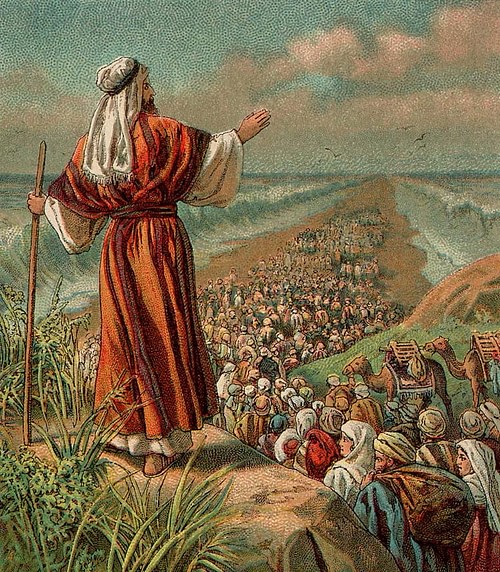
According to the biblical narrative in the Book of Exodus, the patriarch Moses led his people, the Israelites, out of the bondage of slavery in Egypt and toward the 'promised land' of Canaan where their god had promised them they would live in peace in a "land flowing with milk and honey." The Book of Joshua, following the Exodus narrative, tells of the campaigns of the Israelite General Joshua in the land of Canaan subduing the populace with the help, and by command of, his god, most famously destroying the city of Jericho. Following the conquest, the land was divided among Joshua's people and, in time, the kingdoms of Israel and Judah were established.
Moses had been directed to lead his people to Canaan because, again according to the Bible, that had been their homeland prior to their move to Egypt. Abraham, the Patriarch had brought his tribe there, according to the Book of Genesis, from the region of Ur in Mesopotamia and, through his son Isaac and grandson Jacob (also known as Israel), established his people and developed a culture distinct from that of the Canaanites.
Jacob's youngest son Joseph, though a series of dramatic events, was imprisoned in Egypt but freed owing to his ability to rightly interpret the pharaoh's dreams and came to hold a position of power. He saved Egypt and the surrounding regions from famine through careful planting and storage of grain during the years when there was plenty and Jacob and his tribe came to Egypt for food. Afterwards, they stayed until, according to the Book of Exodus, they became “too plentiful” and, fearing their strength in numbers, the Egyptians enslaved them.
When the god of the Israelites freed them through the Ten Plagues orchestrated by Moses, they were to return to their homeland. The Bible then narrates the conquest and depopulation of the region as Joshua, dutifully following the dictates of his god Yahweh, emerges victorious and again establishes the Israelites in the land.
Israel & Judah
As noted, scholars date the invasion of the Israelites to about 1250 BCE and archaeological excavations in the region have confirmed some kind of disturbance in the region between c. 1250 and c. 1150 BCE which resulted in the destruction of Canaanite towns and cities. These ruins, however, do not always match the descriptions given in the Book of Joshua and, further, the Canaanites are regularly depicted as a unified people in the narrative when, actually, they were not.
Even so, the destruction of the cities and the absence of further development of the culture, indicate that some catastrophic event, or series of events, impacted the people of Canaan significantly. The time period in which General Joshua allegedly conquered the land of Canaan corresponds with a period of general upheaval in the ancient world from the destruction of Troy by the Achaeans to the fall of the Hittite Empire, the ruin of the great city of Ugarit and the harassment of coastal towns by the mysterious Sea Peoples. Whatever the cause, by c.1080 BCE, the Kingdom of Israel had been established with Saul (c. 1080-1010 BCE) as king.
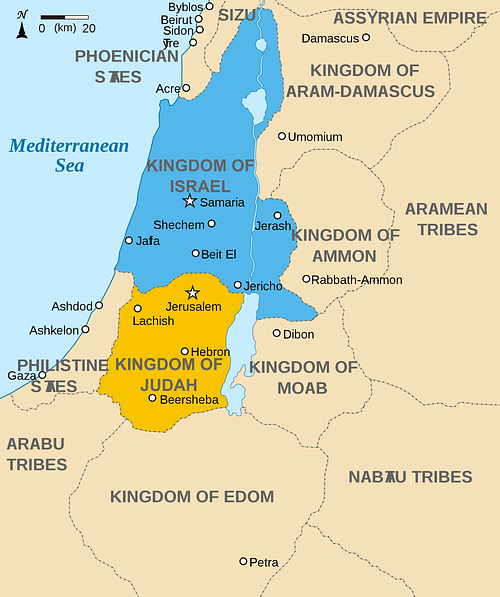
Saul was followed by King David (c. 1035-970 BCE) and his son Solomon (c. 965-931 BCE) and, following Solomon's death, the kingdom split in two with Israel as the northern state and Judah the southern. In an effort to consolidate power in the region and unify their people, these kings (according to the Bible) emphasized belief in a single deity, Yahweh, creator of heaven and earth, and so initiated monotheistic belief in Canaan. Scholars continue to debate whether monotheism was the construct of the Jews of the United Monarchy of Israel or initiated by the so-called “heretic king” Akhenaten of Egypt (1353-1336 BCE). Sigmund Freud has famously advanced the theory that Moses was a priest of Akhenaten who brought Egyptian monotheism to Canaan following the exodus.
Israel was destroyed in the Assyrian invasion of 722 BCE after which, in keeping with Assyrian policy, the population was relocated to cities in Mesopotamia and other people brought to replace them in the region. The Assyrian Empire fell to a coalition led by Babylonians and Medes in 612 BCE and, afterwards, Judah was attacked by the Babylonians who sacked their capital city of Jerusalem and destroyed the temple. Further military incursions by the Babylonians between 589-582 BCE destroyed the rest of the southern kingdom.
Conclusion
The Babylonians, in their turn, were conquered by the Persians under Cyrus the Great (d. 530 BCE) who allowed the Jews to return to their homeland in 538 BCE. There, during the era known as the Second Temple Period (c. 515 BCE - 70 CE) the clergy would revise their religious beliefs and canonize their scripture to establish Judaism as recognized in the modern day.
The empire Cyrus created was toppled by the armies under Alexander the Great (356-323 BCE) who introduced Hellenistic culture and beliefs to Canaan. Following Alexander, the Seleucids held the region until the Maccabean Revolt of c. 168 BCE, led by Judas Maccabeus, freed the region from occupation and established the Hasmonean Dynasty of the Jews. Although the Maccabean Revolt is traditionally characterized as a fight for religious freedom and autonomy, it is possible it was a civil war between Jewish factions who embraced the Hellenism of the Seleucid Empire and those who rejected it with the Seleucid king Antiochus IV Epiphanes only involved as an ally of the Hellenistic Jews.
The Hasmonean Dynasty engaged in trade and occasional conflict with the wealthy Kingdom of Nabatea (in modern-day Jordan) which attracted the attention of Rome. In 63 BCE, the region was claimed by Pompey the Great during the late Roman Republic and, after Augustus Caesar came to power in 31 BCE, it was made part of the Roman Empire and known as Roman Judea. The Jewish-Roman Wars of 66-136 CE depopulated the region and the emperor Hadrian, grown weary of dealing with the Judeans, banished all Jews from the region after 136 CE and renamed it Syria-Palaestina. The diaspora which followed the wars and Hadrian's edict, after centuries of similar conflict in the region, finally obscured the identity of the original inhabitants of the land.
Whoever the ancient Canaanites were, their identity was lost in the successive invasions by foreign people interested in controlling an important hub of commerce. Whatever else Canaan may have been, a homeland to some and a 'promised land' to others, it was strategically located to facilitate trade. Control of the region, and the wealth it could generate, was therefore sought by numerous foreign powers. By the time the region was part of the Eastern Roman or Byzantine Empire in the 4th century CE, the land known as Canaan was no more than a narrow territory at the edge of the Mediterranean Sea approximating modern-day Lebanon.