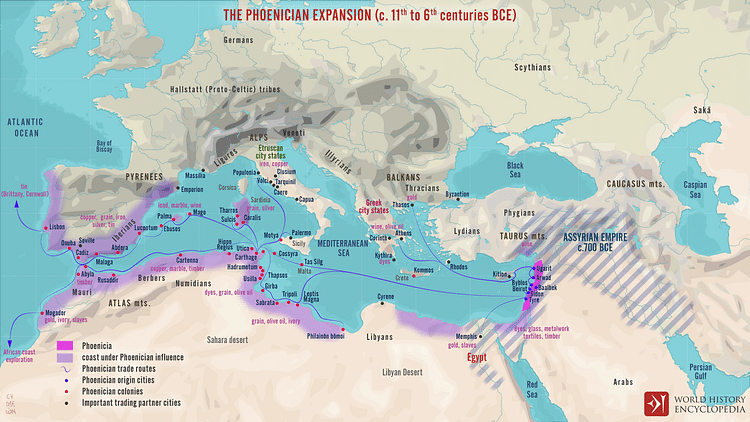
Tyre (in modern-day Lebanon) is one of the oldest cities in the world, dating back over 4,000 years, during which it has been inhabited almost continuously. It was one of the most important, and at times the dominant, city of Phoenicia, whose citizens claimed it had been founded by the great god Melqart.
The city was an ancient Phoenician port and industrial center which, in myth, is known as the birthplace of Europa (who gave Europe its name) and Dido of Carthage (who gave aid to and fell in love with Aeneas of Troy). The name means 'rock' and the city consisted of two parts, the main trade center on an island, and 'old Tyre', about a half-mile opposite on the mainland. The old city, known as Ushu (an earlier name for Melqart), was founded c. 2750 BCE, and the trade center grew up shortly after. In time, the island complex became more prosperous and populated than Ushu and was heavily fortified.
The prosperity of Tyre attracted the attention of King Nebuchadnezzar II of Babylon (r. 605/604-562 BCE) who lay siege to the city for 13 years in the 6th century BCE without breaking their defenses. During this siege, most of the inhabitants of the mainland city abandoned it for the relative safety of the island city. Ushu became a suburb of Tyre on the mainland and remained so until the coming of Alexander the Great.
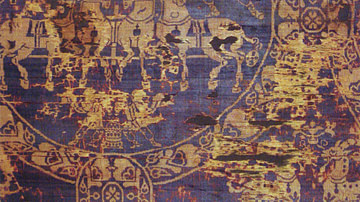
The Tyrians were known as workers in dye from the shells of the Murex shellfish. This purple dye was highly valued and held royal connotations in the ancient world. It also gave the Phoenicians their name from the Greeks - Phoinikes - which means "purple people". The city-state was the most powerful in all of Phoenicia after surpassing its sister state Sidon.
Tyre is referenced in the Bible in the New Testament where it is claimed that both Jesus and Saint Paul the Apostle visited the city and remains famous in military history for Alexander the Great's siege. Today, Tyre is listed by UNESCO as a World Heritage Site and efforts continue to preserve its history in the face of ongoing conflict in the region.
Mythological & Historical Origins
Tyre is repeatedly referenced by ancient historians as having been established by the gods. In one tale, two divine brothers – Shamenrum and Ushu – living on the mainland, begin to argue, possibly over land rights, as Shamenrum was an agriculturalist who made huts from reeds (establishing permanent settlements), while Ushu was a mighty hunter who roamed at will and made clothing from the skins of animals.
When the argument (the details of which are not given) could not be resolved, Ushu created a small raft from the log of a tree struck by lightning and left the mainland, landing on an island off the coast. He established a temple there and named the island Tyre after the mermaid Tyros who may have helped direct his raft. In this story, the island is free-floating with no fixed position (possibly why Ushu requires the help of Tyros to land there) and is only anchored once Ushu builds his temple there in honor of the divine forces of fire and wind, driving his pillars of emerald and gold so deeply into the earth that they hold the island in place.
In another version of the island’s origins, the goddess Astarte planted an olive tree on a floating island with an eagle in its branches and a serpent entwined about its base. The island would continue to float until the eagle was sacrificed to the gods and, when Ushu arrived there on his raft, the eagle willingly gave its life and Ushu established his temple as a home for the gods. The Greek historian Herodotus (l. c. 484-425/413 BCE) records his visit to Tyre in Book II.44 of his Histories where he relates how the priests of Tyre told him the city was founded by Heracles (not the same demigod as the son of Zeus famous for the 12 Labors) who at that time was worshipped as Melqart and was the same deity as Ushu:
I talked to the priests of the god there and asked them how long ago the sanctuary was founded and…according to them, the sanctuary of the god was founded at the same time as Tyre, which was 2,300 years ago.
Archaeological evidence dates the earliest human habitation of Tyre at c. 2900 – 2750 BCE with the earliest homes having been abandoned and permanent habitation continuing from the later date. The city was already thriving during the period of Egypt’s 18th Dynasty (c. 1550-1292 BCE) when they supplied the ruling house of Egypt with the expensive clothing dyed in the shade known as Tyrian Purple which would continue to be associated with royalty through the Roman Empire and even later. Tyre continued to prosper during the reign of the Assyrian king Ashurnasirpal II (884-859 BCE) who lists it among the cities who paid him tribute that included silver, gold, tin, bronze and other precious metals and materials.
Tyre's Golden Age
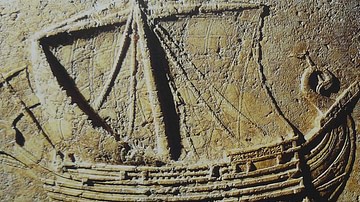
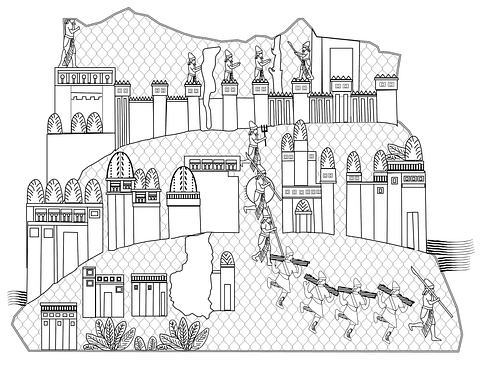
Tyre was in its golden age around the 10th century BCE and, in the 8th, was colonizing other sites in the area and enjoying great wealth and prosperity owing primarily to an alliance with Israel. The Tyrian alliance and trade agreement with David, King of Israel, was initiated by the King of Tyre, Abibaal who sent the new king timber from the fabled cedars of Lebanon (as Abibaal's son, Hiram, is said to have done for King David's son Solomon). This alliance resulted in a very lucrative partnership which benefited both parties. According to scholar Richard Miles:
Commercially, this deal not only gave Tyre privileged access to the valuable markets of Israel, Judaea, and northern Syria, it also provided further opportunities for joint overseas ventures. Indeed, a Tyrian-Israelite expedition travelled to the Sudan and Somalia, and perhaps even as far as the Indian Ocean. (32)
Another development which encouraged the wealth of Tyre seems to have been a religious revolution in the city under the reigns of Abibaal and Hiram which elevated Melqart over one of the more popular divine couples of Phoenician religion, Baal and Astarte. The primacy of Melqart (whose name means 'King of the City') drew power away from the priests of the traditional pantheon of the gods and placed it at the disposal of the palace as Melqart was closely associated with the ruling house. Miles comments:
It seems that a desire to bring the temples to heel lay behind the royal decision to replace the traditional chief deities of Tyre with a new god, Melqart. (32)
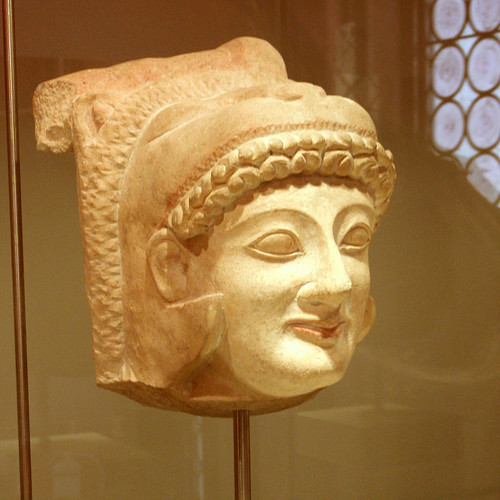
As noted, Melqart was not new to Tyre and had always been venerated there but now took on greater authority and prominence. The Tyrians were never monotheistic but the elevation of Melqart in the city pleased the monotheistic Israelite ruling house which venerated the one god Yahweh and furthered a productive working relationship in trade. The Tyrians provided Israel with precious metals for their temple and the famous, purple-dyed clothing for royalty in exchange for necessary goods and luxuries. Miles writes:
In exchange [for precious metals and clothing], the Israelites would deliver annual provisions of over 400,000 liters of wheat and 420,000 liters of olive oil – a great boon for Tyre, with its limited territory. (32)
The result was not only an increase in the wealth of the palace but, through a more efficient distribution of that wealth, increased prosperity for the whole of the city. This affluence attracted the attention of the Babylonians after the fall of the Assyrian Empire in 612 BCE and King Nebuchadnezzar II lay siege to the city in 586 BCE. The siege lasted thirteen years and, although the walls of Tyre held, its commercial ventures suffered, and prosperity declined. Tyre revived under the Persian Achaemenid Empire which took the city in 539 BCE and held it until the coming of Alexander the Great.

Alexander the Great & the Siege
Although the Persians eventually placed their own governors in Phoenician cities, they did not interfere with the religious or political traditions already established and, at first anyway, Tyre was allowed to keep its king who was still associated with Melqart. The king now, not the priests, was the "bridge between the temporal and celestial worlds, and the needs of the heavenly gods could closely correspond with the political exigencies of the palace" (Miles, 33). This new religious policy encouraged a more closely-knit bond among the people of the city by designating them as set apart from the other city-states of Phoenicia and, so, special in the eyes of their god. Miles writes:
The king even introduced an elaborate new ceremonial to celebrate the annual festival of Melqart. Each spring, in a carefully choreographed festival called the egersis, an effigy of the god was placed on a giant raft before being ritually burnt as it drifted out to sea while hymns were sung by the assembled crowds. For the Tyrians, as for many other ancient Near eastern peoples, the emphasis fell upon the restorative properties of fire, for the god himself was not destroyed but revived by the smoke, and the burning of the effigy thus represented rebirth. To emphasize the importance of the egersis in maintaining the internal cohesion of the Tyrian people, all foreigners had to leave the city for the duration of the ceremony. (33-34)
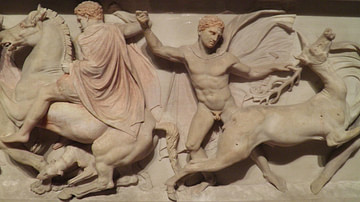
It was this ceremony, and the importance it held for the people, which would bring about Tyre's destruction and the slaughter or enslavement of the populace. In 332 BCE, Alexander the Great arrived at the city during his conquest of the Achaemenid Empire. Fresh from the subjugation of Sidon, which had surrendered and offered lavish gifts, he demanded Tyre's immediate surrender. Following Sidon's lead, the Tyrians acknowledged Alexander's greatness and presented him with gifts equal in value to those he had received from Sidon.
All seemed to be going well and, pleased with their submission, Alexander said he would present a sacrifice in honor of their god in the Temple of Melqart. The Tyrians could not allow this as it would be sacrilegious for a foreigner to present a sacrifice in what was considered the literal home of their god and even more so as the ceremony of the egersis was close at hand. Scholar Ian Worthington describes what followed:
Azemilk, King of Tyre, proposed a compromise. Tyre would become Alexander's ally, but he should sacrifice on the mainland at Old Tyre, opposite the island. An angry Alexander sent envoys to say this was unacceptable and that the Tyrians had to surrender. They murdered the envoys and threw them off their walls. (105)
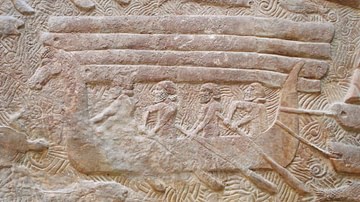
Alexander then ordered the siege of Tyre. He dismantled much of the old mainland city of Ushu as well as using fallen debris, rock, and felled trees, filling in the sea between the mainland and the island to create a land bridge for his war machines. Over the centuries since, this caused heavy sedimentation to occur and permanently linked the island to the mainland, which is why Tyre is not an island today. After a siege of seven months, Alexander used his man-made causeway to batter down the walls of Tyre and take the city.
Tyre's 30,000 inhabitants were either massacred or sold into slavery, and the city was destroyed by Alexander in his rage at their having defied him for so long. The fall of Tyre led to the further development of Carthage (already established as a Phoenician colony in c. 814 BCE) as many survivors of the siege, who were able to escape Alexander's wrath by bribery or stealth, emigrated to their former colony in the north of Africa.
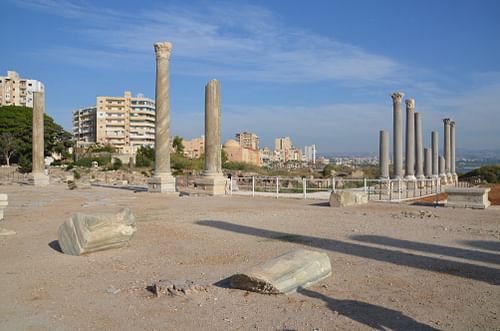
Following Alexander's death in 323 BCE, his generals fought each other over the territories he had conquered with different regions controlled, sometimes in fairly quick succession, by one or the others. The general Laomedon of Mytilene held Tyre at first and it changed hands throughout the conflict (known as the Wars of the Diadochi, the wars of Alexander’s successors) until it was taken by Antigonus I in 315 BCE whose successors held it until Phoenicia was conquered by Antiochus III (r. 223-187 BCE) of the Seleucid Empire in 198 BCE.
The Coming of Rome
Antiochus III was concerning himself with the expansion of his own territories when the Second Punic War broke out between Rome and Carthage in 218 BCE. Hannibal Barca (l. 247-183 BCE) the great Carthaginian general, was aided and supported by Philip V of Macedon (r. 221-179 BCE) who convinced Antiochus III to join him in conquering Egypt in c. 205 BCE. Egypt was Rome’s major source of grain, however, and they threatened Antiochus III with dire consequences should he proceed with Philip V’s proposal. Antiochus III backed off and the Romans defeated Philip V at the Battle of Cynoscephalae in 197 BCE.
Antiochus III, fearing Rome might eliminate him next, made a preemptive strike in 191 BCE and then 190 BCE at the Battle of Magnesia where he was defeated. The Treaty of Apamea of 188 BCE severely reduced Antiochus III’s territory and placed a crippling war indemnity on the Seleucids which contributed to the fall of their empire. Seleucid monarchs began to concern themselves more with their own safety, comfort, and luxury than with the function of the state, weakening its hold on a number of regions and, in 126 BCE, Tyre was able to declare its independence.
The city suffered another decline during the Mithridatic Wars (89-63 BCE) between Mithridates VI (r. 120-63 BCE) of Pontus and Rome which also involved Tigranes the Great (r. c. 95-c. 56 BCE) who allied himself with Mithridates VI. Although Tyre was able to maintain its independence, the incessant warfare in the region severely hampered commercial ventures leading to economic decline.
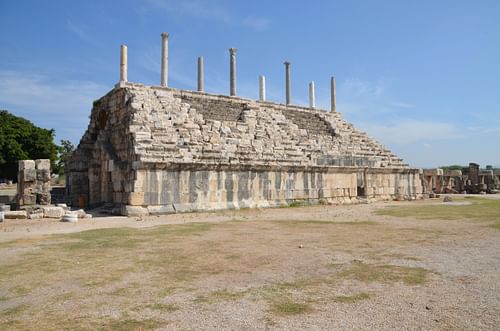
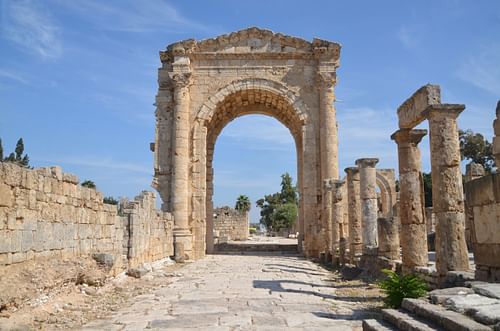
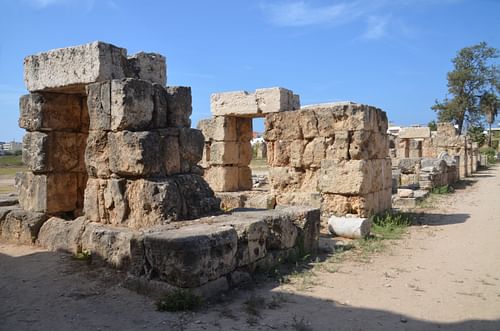
The Romans took the city as a colony in 64 BCE, when the Roman general and consul Pompey the Great annexed the whole of Phoenicia. Tyre was rebuilt and refurbished under the Romans who, ironically, had destroyed the city of Carthage where the surviving Tyrians had earlier fled to. Rome built the roads, monuments, and aqueducts which can still be seen in the modern day and the city flourished under Roman rule but declined after the fall of the Roman Empire. It continued on as a port city under the eastern half of Rome, the Byzantine Empire, until the 7th century CE when it was taken in the Muslim conquest of the region.
Conclusion
The city was controlled by Christian Crusaders in 1124 following the First Crusade and became an important trade center linking the West with the East via the Silk Road. During this time, Tyre continued to produce its famous purple dye and prospered as the seat of an archbishopric of the Church and one of the most important defenses of the Kingdom of Jerusalem in maintaining a Christian presence in the region.
Tyre was taken by the Muslim Mamluk Sultanate in 1291 and, afterward, the production of purple dye and garments ended as cheaper dyes were now available. In 1516, the city became part of the Ottoman Empire who held it through 1918 when, after the success of the Arab Revolt, it became part of the Arab Kingdom of Syria. By this time, the Tyrians relied largely on the fishing industry – which had always been an important aspect of their economy – and far less on the production of the kinds of crafts that characterized Tyre’s past greatness.
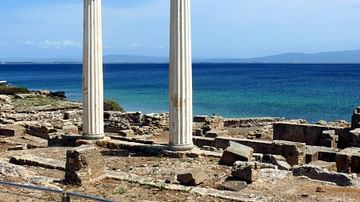
In the present day, Tyre relies primarily on tourism to sustain its economy. Archaeological excavations began there in earnest in 1946 and have continued, sporadically, ever since. Continuing conflict in the region throughout the latter part of the 20th century up through the present has hampered archeological work and, at times, completely stalled tourism, damaging the economy and preventing further exploration of one of the greatest cities of antiquity.