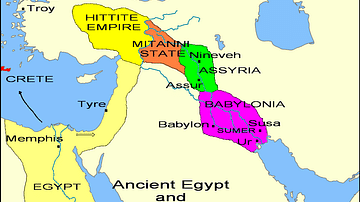
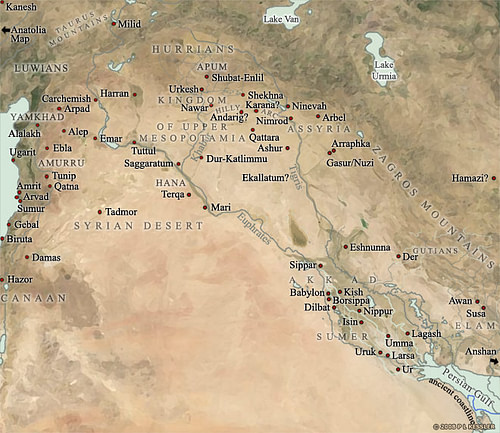
Mesopotamia (from the Greek, meaning 'between two rivers') was an ancient region located in the eastern Mediterranean bounded in the northeast by the Zagros Mountains and in the southeast by the Arabian Plateau, corresponding to modern-day Iraq and parts of Iran, Syria, Kuwait, and Turkey and known as the Fertile Crescent and the cradle of civilization.
The 'two rivers' of the name refer to the Tigris and the Euphrates and the land was known as 'Al-Jazirah' (the island) to the Arabs as a fertile land surrounded by water. The term "Fertile Crescent" was coined by Egyptologist J.H. Breasted (l. 1865-1935) in 1916 to describe the region at the north-end of the Persian Gulf, associated with the biblical Garden of Eden.
Mesopotamia was the home of many different civilizations spanning thousands of years which contributed significantly to world culture and progress. Many of the aspects of daily life taken for granted in the present day, such as writing, the wheel, a code of laws, the sail, the concept of the 24-hour day, beer-brewing, civil rights, and irrigation of crops all were first developed in the land between two rivers which was home to the great Mesopotamian civilizations.
The Cradle of Civilization
Unlike the more unified civilizations of Egypt or Greece, Mesopotamia was a collection of varied cultures whose only real bonds were their script, their gods, and their attitude toward women. The social customs, laws, and even language of the Sumerian people differs from the Akkadian Period, for example, and cannot be assumed to correspond to those of the Babylonian Civilizations; it does seem, however, that the rights of women (during some periods), the importance of literacy, and the pantheon of the gods were indeed shared throughout the region, though the gods had different names in various regions and periods.
As a result of this, Mesopotamia should be more properly understood as a region that produced multiple empires and civilizations rather than any single civilization. Even so, Mesopotamia is known as the “cradle of civilization” primarily because of two developments that occurred there, in the region of Sumer, in the 4th millenium BCE:
- the rise of the city as recognized today.
- the invention of writing (although writing is also known to have developed in Egypt, in the Indus Valley, in China, and to have taken form independently in Mesoamerica).
The invention of the wheel is also credited to the Mesopotamians and, in 1922 CE, the archaeologist Sir Leonard Woolley discovered “the remains of two four-wheeled wagons, [at the site of the ancient city of Ur] the oldest wheeled vehicles in history ever found, along with their leather tires” (Bertman, 35). Other important developments or inventions credited to the Mesopotamians include, but are by no means limited to, domestication of animals, agriculture and irrigation, common tools, sophisticated weaponry and warfare, the chariot, wine, beer, demarcation of time into hours, minutes, and seconds, religious rites, the sail (sailboats), and legal codes. Orientalist Samuel Noah Kramer, in fact, has listed 39 `firsts' in human civilization that originated in Sumer. These include:
The First Schools, The First Case of `Apple Polishing', The First Case of Juvenile Delinquency, The First `War of Nerves', The First Bicameral Congress, The First Historian, The First Case of Tax Reduction, The First `Moses', The First Legal Precedent, The First Pharmacopoeia, The First `Farmer's Almanac', The First Experiment in Shade-Tree Gardening, Man's First Cosmogony and Cosmology, The First Moral Ideals, The First `Job', The First Proverbs and Sayings, The First Animal Fables, The First Literary Debates, The First Biblical Parallels, The First `Noah', The First Tale of Resurrection, The First `St. George', The First Case of Literary Borrowing, Man's First Heroic Age, The First Love Song, The First Library Catalogue, Man's First Golden Age, The First `Sick' Society, The First Liturgic Laments, The First Messiahs, The First Long-Distance Champion, The First Literary Imagery, The First Sex Symbolism, The First Mater Dolorosa, The First Lullaby, The First Literary Portrait, The First Elegies, Labor's First Victory, The First Aquarium.
![Lion of Babylon [Detail]](https://www.worldhistory.org/img/r/p/500x600/293.jpg?v=1709047443)
Archaeological excavations starting in the 1840s CE have revealed human settlements dating to 10,000 BCE in Mesopotamia that indicate that the fertile conditions of the land between two rivers allowed an ancient hunter-gatherer people to settle in the land, domesticate animals, and turn their attention to agriculture and the development of irrigation. Trade soon followed, and with prosperity came urbanization and the birth of the city. It is generally thought that writing was invented due to trade, out of the necessity for long-distance communication, and for keeping more careful track of accounts.
Learning & Religion
Mesopotamia was known in antiquity as a seat of learning, and it is believed that Thales of Miletus (l. c. 585 BCE, known as the 'first philosopher') studied there. As the Babylonians believed that water was the 'first principle' from which all else flowed, and as Thales is famous for that very claim, it seems probable he studied in the region.
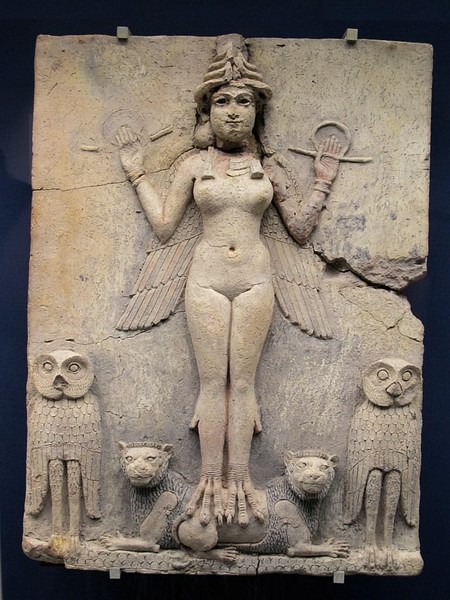
Intellectual pursuits were highly valued across Mesopotamia, and the schools (devoted primarily to the priestly class) were said to be as numerous as temples and taught reading, writing, religion, law, medicine, and astrology. There were over 1,000 deities in the pantheon of the gods of the Mesopotamian cultures and many stories concerning the gods (among them, the creation myth, the Enuma Elish). It is generally accepted that biblical tales such as the Fall of Man and the Great Flood (among many others) originated in Mesopotamian lore, as they first appear in Mesopotamian works such as The Myth of Adapa and the Epic of Gilgamesh, the oldest written story in the world. The Mesopotamians believed that they were co-workers with the gods and that the land was infused with spirits and demons (though `demons' should not be understood in the modern, Christian, sense).
The beginning of the world, they believed, was a victory by the gods over the forces of chaos but, even though the gods had won, this did not mean chaos could not come again. Through daily rituals, attention to the deities, proper funeral practices, and simple civic duty, the people of Mesopotamia felt they helped maintain balance in the world and kept the forces of chaos and destruction at bay. Along with expectations that one would honor one's elders and treat people with respect, the citizens of the land were also to honor the gods through the jobs they performed every day.
Jobs
Men and women both worked, and “because ancient Mesopotamia was fundamentally an agrarian society, the principal occupations were growing crops and raising livestock” (Bertman, 274). Other occupations included those of the scribe, the healer, artisan, weaver, potter, shoemaker, fisherman, teacher, and priest or priestess. Bertman writes:
At the head of society were the kings and priests served by the populous staff of palace and temple. With the institution of standing armies and the spread of imperialism, military officers and professional soldiers took their place in Mesopotamia's expanding and diverse workforce. (274)
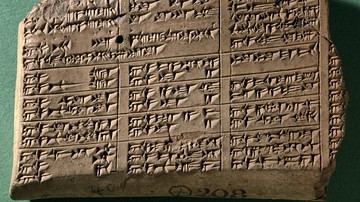
Women enjoyed nearly equal rights and could own land, file for divorce, own their own businesses, and make contracts in trade. Contracts, business arrangements, and correspondence were written in cuneiform script on clay tablets and signed with an imprint from a person's cylinder seal, which was one's form of identification. Once the tablet dried, it was sometimes placed in a clay envelope and sealed again so only the recipient could read the letter or contract. Cuneiform script was used in writing Semitic languages, such as Babylonian, or others like Sumerian and remained in use until replaced by alphabetic script. Receipts for goods received were also written on cuneiform tablets (as everything was, including literature) and these have all lasted much longer than documents written on papyrus or paper.
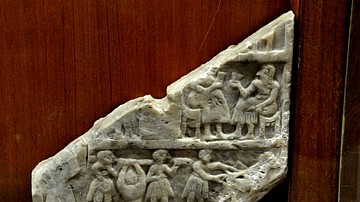
The earliest beer receipt in the world comes from Mesopotamia, known as the Alulu Receipt (c. 2050 BCE), written in the city of Ur. The early brewers of beer and wine, as well as the healers in the community, were initially women. These trades were later taken over by men, it seems, when it became apparent they were lucrative occupations. The work one did, however, was never considered simply a `job' but one's contribution to the community and, by extension, to the gods' efforts in keeping the world at peace and in harmony.
Buildings & Government
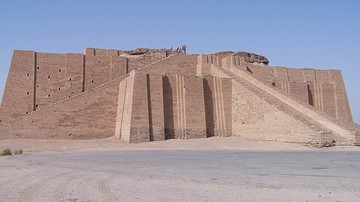
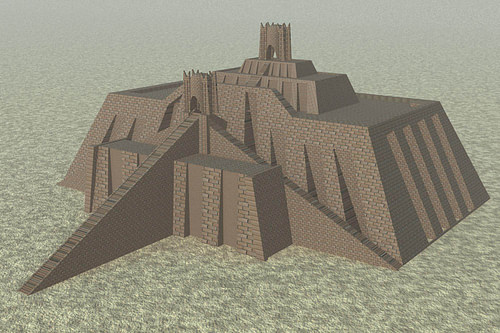
The temple, at the center of every city (known as a ziggurat, a step-pyramid structure indigenous to the region), symbolized the importance of the city's patron deity who would also be worshipped by whatever communities that city presided over. Every city had its own ziggurat (larger cities, more than one) to honor their patron deity. Mesopotamia gave birth to the world's first cities in history which were largely built of sun-dried brick. In the words of Bertman:
The domestic architecture of Mesopotamia grew out of the soil upon which it stood. Unlike Egypt, Mesopotamia –especially in the south– was barren of stone that could be quarried for construction.” The land was equally devoid of trees for timber, so the people “turned to other natural resources that lay abundantly at hand: the muddy clay of its riverbanks and the rushes and reeds that grew in their marshes. With them, the Mesopotamians created the world's first columns, arches, and roofed structures. (285)
Simple homes were constructed from bundles of reeds lashed together and inserted in the ground, while more complex homes were built of sun-dried clay brick (a practice followed later by the Egyptians). Cities and temple complexes, with their famous ziggurats, were all built using oven-baked bricks of clay which were then painted.
The gods were thought to be present in the planning and execution of any building project and very specific prayers, recited in a set order to the proper deity, were considered of utmost importance in the success of the project and the prosperity of the occupants of the home.
Whichever kingdom or empire held sway across Mesopotamia, in whatever historical period, the vital role of the gods in the lives of the people remained undiminished. This reverence for the divine characterized the lives of both the field worker and the king. The historian Helen Chapin Metz writes:
The precariousness of existence in southern Mesopotamia led to a highly developed sense of religion. Cult centers such as Eridu, dating back to 5000 BCE, served as important centers of pilgrimage and devotion even before the rise of Sumer. Many of the most important Mesopotamian cities emerged in areas surrounding the pre-Sumerian cult centers, thus reinforcing the close relationship between religion and government. (2)
The role of the king was established at some point after 3600 BCE and, unlike the priest-rulers who came before, the king dealt directly with the people and made his will clear through laws of his own devising. Prior to the concept of a king, the priestly rulers are believed to have dictated the law according to religious precepts and received divine messages through signs and omens; the king, while still honoring and placating the gods, was considered a powerful enough representative of those gods to be able to speak their will through his own dictates, using his own voice.
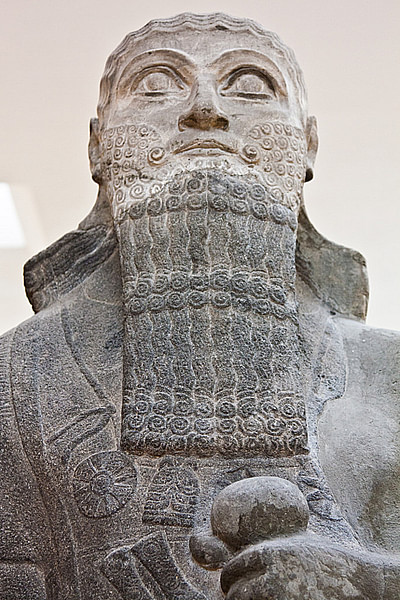
This is most clearly seen in the famous laws of Hammurabi of Babylon (r. 1792-1750 BCE), but a ruler claiming direct contact with the gods was quite common throughout Mesopotamian history, most notably in the Akkadian king Naram-Sin (r. 2261-2224 BCE) who went so far as to proclaim himself a god incarnate. The king was responsible for the welfare of his people and a good king, who ruled in accordance with divine will, was recognized by the prosperity of the region he reigned over.
Still, even very efficient rulers, such as Sargon of Akkad (r. 2334-2279 BCE), had to deal with perpetual uprisings and revolts by factions, or whole regions, contesting his legitimacy. As Mesopotamia was so vast a region, with so many different cultures and ethnicities within its borders, a single ruler attempting to enforce the laws of a central government would invariably be met with resistance from some quarter.
The History of Mesopotamia
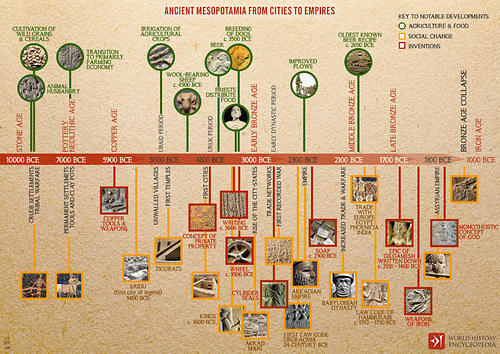
The history of the region, and the development of the civilizations which flourished there, is most easily understood by dividing it into periods:
Pre-Pottery Neolithic Age
Also known as The Stone Age (c. 10,000 BCE though evidence suggests human habitation much earlier). There is archaeological confirmation of crude settlements and early signs of warfare between tribes, most likely over fertile land for crops and fields for grazing livestock. Animal husbandry was increasingly practiced during this time with a shift from a hunter-gatherer culture to an agrarian one. Even so, the historian Marc Van De Mieroop notes:
There was not a sudden change from hunting-gathering to farming, but rather a slow process during which people increased their reliance on resources they managed directly, but still supplemented their diets by hunting wild animals. Agriculture enabled an increase in continuous settlement by people. (12)
As more settlements grew, architectural developments slowly became more sophisticated in the construction of permanent dwellings.
Pottery Neolithic Age (c. 7,000 BCE)
In this period there was a widespread use of tools and clay pots and a specific culture begins to emerge in the Fertile Crescent. Scholar Stephen Bertman writes, “during this era, the only advanced technology was literally 'cutting edge'” as stone tools and weapons became more sophisticated. Bertman further notes that “the Neolithic economy was primarily based on food production through farming and animal husbandry” (55) and was more settled, as opposed to the Stone Age in which communities were more mobile. Architectural advancements naturally followed in the wake of permanent settlements as did developments in the manufacture of ceramics and stone tools.
Copper Age (5,900 – 3,200 BCE)
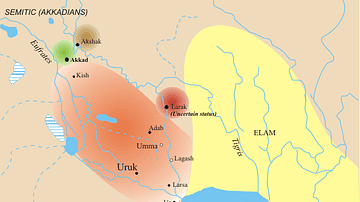
Also known as The Chalcolithic Period owing to the transition from stone tools and weapons to ones made of copper. This era includes the so-called Ubaid Period (c. 5000-4100 BCE, named for Tell al-`Ubaid, the location in Iraq where the greatest number of artifacts were found) during which the first temples in Mesopotamia were built and unwalled villages developed from sporadic settlements of single dwellings. These villages then gave rise to the urbanization process during the Uruk Period (4100-2900 BCE) when cities rose, most notably in the region of Sumer, including Eridu, Uruk, Ur, Kish, Nuzi, Lagash, Nippur, and Ngirsu, and in Elam with its city of Susa.
The earliest city is often cited as Uruk, although Eridu and Ur have also been suggested. Van De Mieroop writes, “Mesopotamia was the most densely urbanized region in the ancient world” (as cited in Bertman, 201), and the cities which grew up along the Tigris and Euphrates rivers, as well as those founded further away, established systems of trade which resulted in great prosperity.
This period saw the invention of the wheel (c. 3500 BCE) and writing (c. 3600 BCE), both by the Sumerians, the establishment of kingships to replace priestly rule, and the first war in the world recorded between the kingdoms of Sumer and Elam (2700 BCE) with Sumer as the victor. During the Early Dynastic Period (2900-2334 BCE), all of the advances of the Uruk Period were developed and the cities, and government in general, stabilized.
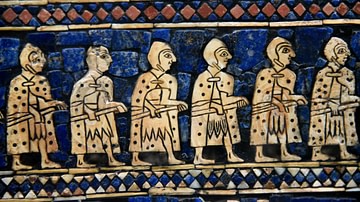
Increased prosperity in the region gave rise to ornate temples and statuary, sophisticated pottery and figurines, toys for children (including dolls for girls and wheeled carts for boys), and the use of personal seals (known as Cylinder Seals) to denote ownership of property and to stand for an individual's signature. Cylinder Seals would be comparable to one's modern-day identification card or driver's license and, in fact, the loss or theft of one's seal would have been as significant as modern-day identity theft or losing one's credit cards.
Early Bronze Age (3,000 – 2119 BCE)
During this period, bronze supplanted copper as the material from which tools and weapons were made. The rise of the city-state laid the foundation for economic and political stability which would eventually lead to the rise of the Akkadian Empire (2334-2218 BCE) and the rapid growth of the cities of Akkad and Mari, two of the most prosperous urban centers of the time. The cultural stability necessary for the creation of art in the region resulted in more intricate designs in architecture and sculpture, as well as the following inventions or improvements:
a number of specific and momentous inventions: the plough and the wheel, the chariot and the sailboat, and the cylinder-seal, the single most distinctive art form of ancient Mesopotamia and a pervasive demonstration of the importance of property ownership and business in the country's daily life. (Bertman, 55-56)
The Akkadian Empire of Sargon the Great was the first multi-national realm in the world and Sargon's daughter, Enheduanna (l.2285-2250 BCE), the first author of literary works known by name. The library at Mari contained over 20,000 cuneiform tablets (books) and the palace there was considered one of the finest in the region.
Middle Bronze Age (2119-1700 BCE)
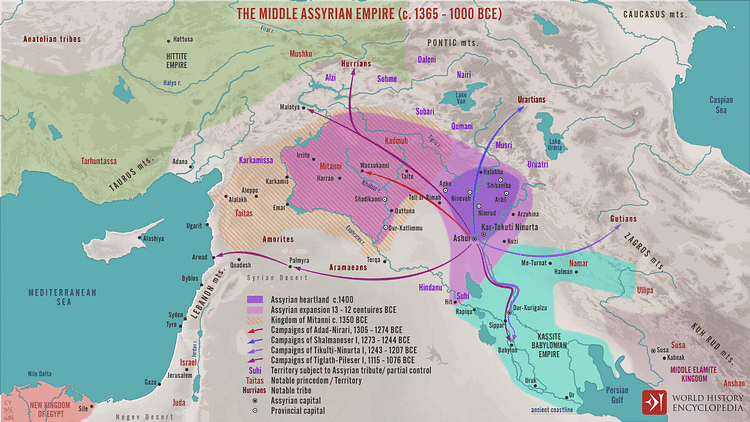
The expansion of the Assyrian Kingdoms (Assur, Nimrud, Sharrukin, Dur, and Nineveh) and the rise of the Babylonian Dynasty (centered in Babylon and Chaldea) created an atmosphere conducive to trade and, with it, increased warfare. The Guti Tribe, fierce nomads who succeeded in toppling the Akkadian Empire, dominated the politics of Mesopotamia until they were defeated by the allied forces of the kings of Sumer.
Hammurabi, King of Babylon, rose from relative obscurity to conquer the region and reign for 43 years. Among his many accomplishments was his famous code of laws, inscribed on the stele of the gods. Babylon became a leading centre at this time for intellectual pursuit and high accomplishment in arts and letters. This cultural centre was not to last, however, and was sacked and looted by the Hittites who were then succeeded by the Kassites.
Late Bronze Age (1700-1100 BCE)
The rise of the Kassite Dynasty (a tribe who came from the Zagros Mountains in the north and are thought to have originated in modern-day Iran) leads to a shift in power and an expansion of culture and learning after the Kassites conquered Babylon. The collapse of the Bronze Age followed the discovery of how to mine ore and make use of iron, a technology which the Kassites and, earlier, the Hittites made singular use of in warfare.
The period also saw the beginning of the decline of Babylonian culture due to the rise in power of the Kassites until they were defeated by the Elamites and driven out. After the Elamites gave way to the Aramaeans, the small Kingdom of Assyria began a series of successful campaigns, and the Assyrian Empire was firmly established and prospered under the rule of Tiglath-Pileser I (r. 1115-1076 BCE) and, after him, Ashurnasirpal II (r. 884-859 BCE) consolidated the empire further. Most Mesopotamian states were either destroyed or weakened following the Bronze Age Collapse c. 1250-c.1150 BCE, leading to a brief "dark age".
Iron Age (1000 – 500 BCE)
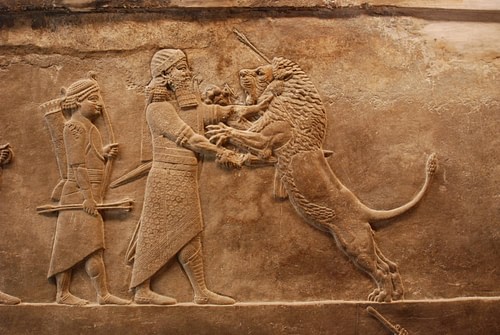
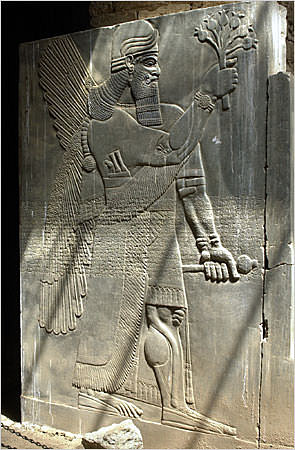
This age saw the rise and expansion of the Neo-Assyrian Empire under Tiglath-Pileser III (r. 745-727 BCE) and that Empire's meteoric rise to power and conquest under the rule of great Assyrian kings such as Sargon II (r. 722-705 BCE), Sennacherib (r. 705-681 BCE), Esarhaddon (r. 681-669 BCE) and Ashurbanipal (r. c. 668-627 BCE, who conquered Babylonia, Syria, Israel, and Egypt). The Empire suffered a decline as rapid as its rise due to repeated attacks on central cities by Babylonians, Medes, and Scythians in 612 BCE.
The tribes of the Hittites and the Mitanni consolidated their respective powers during this time which resulted in the rise of the Neo-Hittite and Neo-Babylonian Empires. King Nebuchadnezzar II (r. 605/604-562 BCE) of Babylon destroyed Jerusalem (588 BCE) during this period and forced the inhabitants of Israel into the “Babylonian Exile”. He was also responsible for extensive construction in Babylon, creating famous buildings such as the Ishtar Gate and the Great Ziggurat (the "Tower of Babel"). The fall of Babylon to Cyrus II of Persia (the Great, r. c. 550 - 530 BCE) in 539 BCE effectively ended Babylonian culture.
Classical Antiquity (500 BCE – 7th century CE)
After Cyrus II took Babylon, the bulk of Mesopotamia became part of the Achaemenid Persian Empire, and this period saw a rapid cultural shift in the region including a number of changes, most notably the loss of the knowledge of cuneiform script. The conquest of the Persians by Alexander the Great in 331 BCE brought Hellenization of the culture and religion but, even though Alexander tried to again make Babylon a city of consequence, its days of glory were now in the past.
After his death, Alexander's general Seleucus I Nicator (r. 305 - 281 BCE) took control of the region and founded the Seleucid Empire (312 - 63 BCE) which ruled until 63 BCE when the land was conquered by the Parthians who were, in turn, dominated by the Sassanians who established the Sassanian Empire (224 - 651 CE). The Sassanians honored the legacies of earlier Mesopotamian civilizations and preserved their contributions.
Between the Parthian Empire (247 BCE - 224 CE) and the Sassanians, the Roman Empire established itself in the region in c. 198 CE, (though Rome had arrived earlier in 116 - 117 CE but withdrew). The Romans improved the infrastructure of their colonies significantly through their introduction of better roads and plumbing and brought Roman Law to the land. Even so, the region was constantly caught up in the wars various Roman emperors waged, first with the Parthians and then Sassanians, over control of the land.
The ancient culture of the region, preserved by the Sassanians, was devastated by the conquest of Mesopotamia by Muslim Arabs in the 7th century CE which resulted in the unification of law, language, religion and culture under Islam. Aspects of the culture were retained but, as Bertman notes, “With the Islamic conquest of 651 CE the history of ancient Mesopotamia ends” (58). Today the great cities that once rose along the Tigris and Euphrates rivers are largely unexcavated mounds or broken bricks on arid plains, and the region of the Fertile Crescent has steadily dwindled into areas resembling wastelands due to human factors (such as overuse of the land through agricultural pursuits or urban development) and climate change.
Legacy
The legacy of Mesopotamia endures today through many of the most basic aspects of modern life such as the sixty-second minute and the sixty-minute hour. Helen Chapin Metz writes,
Because the well-being of the community depended upon close observation of natural phenomena, scientific or protoscientific activities occupied much of the priests' time. For example, the Sumerians believed that each of the gods was represented by a number. The number sixty, sacred to the god An, was their basic unit of calculation. The minutes of an hour and the notational degrees of a circle were Sumerian concepts. The highly developed agricultural system and the refined irrigation and water-control systems that enabled Sumer to achieve surplus production also led to the growth of large cities. (4)
Urbanization, the wheel, writing, astronomy, mathematics, wind power, irrigation, agricultural developments, animal husbandry, and the narratives which would eventually be re-written as the Hebrew Scriptures and provide the basis for the Christian Old Testament all came from the land of Mesopotamia.
As noted, Kramer lists 39 `firsts' from Mesopotamia in his book History Begins at Sumer and yet, as impressive as those `firsts' are, Mesopotamian contributions to world culture do not end with them. The Mesopotamians influenced the cultures of Egypt and Greece through long-distance trade and cultural diffusion and, through these cultures, impacted the culture of Rome which set the standard for the development and spread of Western Civilization. Mesopotamia generally, and Sumer specifically, gave the world some of its most enduring cultural aspects and, even though the cities and great palaces are long gone, that legacy continued into the modern era.
In the 19th century CE, archaeologists of varying nationalities arrived in Mesopotamia to excavate for evidence which would corroborate the biblical tales of the Old Testament. At this time, the Bible was considered the oldest book in the world and the stories found in its pages were thought to be original compositions. The archaeologists who sought physical evidence to support the biblical stories found exactly the opposite once the ancient clay tablets were discovered and it was understood that the marks on them were not designs but a form of writing.
These cuneiform tablets were deciphered by the scholar and translator George Smith (l. 1840-1876 CE) in 1872 CE and this opened up the ancient civilizations of Mesopotamia to the modern world. The story of the Great Flood and Noah's Ark, the story of the Fall of Man, the concept of a Garden of Eden, even the complaints of Job had all been written centuries before the biblical texts by the Mesopotamians.
Once cuneiform could be read, and the ancient world of Mesopotamia opened up to the modern age, it transformed people's understanding of the history of the world and themselves. The discovery of the Sumerian Civilization and the stories of the cuneiform tablets encouraged a new freedom of intellectual inquiry into all areas of knowledge. It was now understood that the biblical narratives were not original Hebrew works, the world was obviously older than the church had been claiming, there were civilizations which had risen and fallen long before anyone previously thought and, if these claims by authorities of church and schools had been false, perhaps others were as well.
The spirit of inquiry in the late 19th century was already making inroads into challenging the paradigms of accepted thought when Smith deciphered cuneiform but the discovery of Mesopotamian culture and religion encouraged this further. In ancient times, Mesopotamia impacted the world through its inventions, innovations, and religious vision; in the modern day it literally changed the way people understood the whole of history and one's place in the continuing story of human civilization.