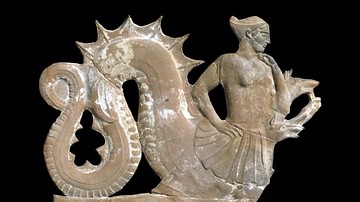
The Mediterranean island of Sicily, with its natural resources and strategic position on ancient trading routes, aroused the intense interest of successive empires from Carthage to Athens to Rome. Consequently, the island was never far from centre-stage in regional politics and was very often a theatre of war throughout the Classical period. Invasions, tyrants, and battles did, though, eventually give way to centuries of relative peace and prosperity as a Roman province. Sicily's historical legacy today includes some of the most impressive and best-preserved ancient monuments in the Mediterranean, testimony to the island's rich cultural history.
Early History
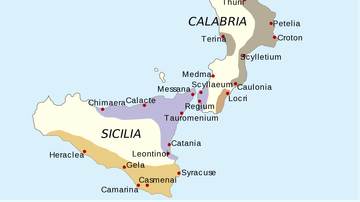
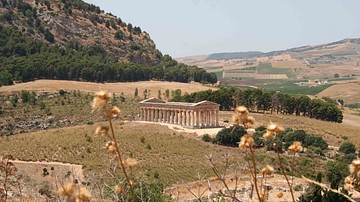
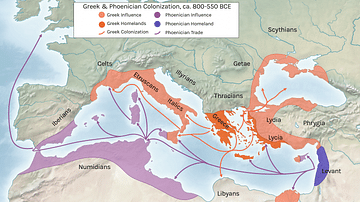
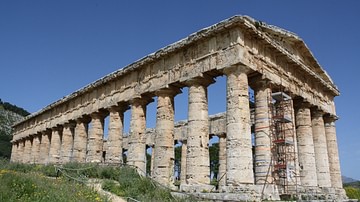
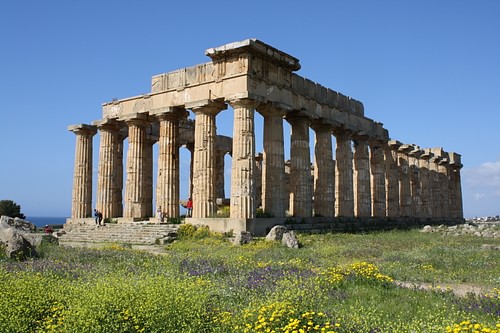
There were three indigenous groups on ancient Sicily: the Elymi in the western part of the island, the Sicani in the centre, and the Sicels in the east - the latter being the root of the island's name. According to Thucydides, the origins of these groups could be traced back to Troy, Iberia, and mainland Italy, respectively. Finds of pottery and copper ingots indicate that the island traded with Late Bronze Age peoples such as the Mycenaeans and Cypriots. Although traditional accounts have the Phoenicians as the first colonisers there is no evidence that they pre-dated Greek colonists. Motya, Panormus and Soloeis were the principal Phoenician settlements whilst Segesta, Eryx and Entella were the main Elymi sites, all of which were allied to Carthage. Greek colonisation began c. 735 BCE and exerted a strong political and cultural influence on local communities either directly or via trade. This Hellenization was most evident in architecture with great Doric temples being built across the island. The spread of urban settlements and the first issues of Sicilian coinage in the late 6th century BCE attest to the prosperity enjoyed by many of the city-states or poleis. The Phoenician settlements rigorously rebuffed the Greek advancement into their territory, notably in c. 580 BCE against Pentathlus and again in c. 510 BCE against Dorieus.
Tyrants, Carthage, & Athens
The form of government of the various poleis followed the various Greek models but tyrants were prevalent. Acragas (Agrigento) and Gela were amongst the earliest poleis to be ruled by tyrants and Hippocrates of Gela was the first of a long line of famous Sicilian tyrants (it should be noted that the Greek term 'tyrant' signified a single ruler and he was not always a tyrant in the modern, negative sense of the term). Hippocrates' successor was Gelon (r. 491-478 BCE), and he moved his capital to Syracuse which had originally been founded as a colony of Corinth in 734 BCE. Syracuse would, following the defeat of Carthage and her Sicilian allies at the battle of Himera in 480 BCE, become the dominant polis on the island and second only to Athens as the largest in the Greek world, eventually over-taking it in terms of population.
From the 5th century BCE, democracy became the dominant form of government, but the still mutually independent poleis now began to attract the interest of the great maritime power of the age: Athens. A first unsuccessful attempt to increase Athenian influence in the region between 427 and 424 BCE was followed by the spectacular flop known as the Sicilian Expedition between 415 and 413 BCE. Attacking Syracuse, the Athenian plan was masterminded by Alcibiades, but ultimately the Athenians came unstuck and lost their entire invasion force. Athens had over-estimated any local support they might have received from disgruntled Sicilian poleis and under-estimated the fortifications and resolve of the Syracusans. When Gylippus arrived with a relief force from Corinth, the fate of the Athenians was sealed and their two commanders were executed in a shocking blow to Athenian military pride.
Syracuse then became an active ally to Sparta as the Peloponnesian War rumbled on against Athens and her allies. Carthage, meanwhile, seized the opportunity to increase her influence, capturing Selinus and Himera in 409 BCE and then Acragas and Gela three years later. Syracuse regained the initiative, however, under the rule of one of the greatest leaders in the island's history: Dionysius I, gifted general, politician and patron of the arts. Taking power in 405 BCE and employing a large mercenary army, Syracusan domination of the island followed, and the Carthaginians could only maintain a toe-hold in the west, a situation which remained unchanged until the death of Dionysius in 367 BCE. Dionysius also became a useful ally to Sparta during the Corinthian Wars between 395 and 386 BCE, and he expanded the Syracusan Empire to include large parts of the southern Italian mainland. He was an innovative military leader and is credited with employing siege towers and bolt throwing artillery for the first time in Greek warfare.
Hellenistic & Roman Sicily
In the Hellenistic period, and following the end of Dionysius I's reign, Syracuse was obliged to call on Corinth to help meet the threat of Carthage. Timoleon duly brought victory at the battle of Crimisius c. 341 BCE, and he re-established Syracusan control of her kingdom, eliminating tyrannies and embarking on a programme of restoration and encouraging a new influx of colonists from Greece and Italy. Many Sicilian states once more prospered, but after the death of Timoleon, political chaos ensued. However, following a tumultuous period of oligarchic rule, a powerful tyrant once more revived the fortunes of Syracuse. Agathocles took power in 317 BCE and declared himself king of Sicily in c. 305 BCE, after seizing most of the island. Once again, though, when a strong individual ruler died, unrest and decline swiftly followed. The fortunes of the city revived under the 3rd century BCE rulers Pyrrhus and Hieron II, but Sicily as a whole was, in the coming decades, about to lose its independence.
Carthage continued to be an ever-present threat to Sicilian cities, but by the mid-3rd century BCE a new player had arrived on the scene: Rome. The two great powers would clash in the Punic Wars and Sicily became the battleground. Rome eventually won the day and Sicily became a Roman province, what would be the first of many. Hieron II of Syracuse had switched sides to join Carthage, but with the city's fall at Roman hands in 211 BCE, the island was at last unified into a single governable unit ruled by a foreign power.
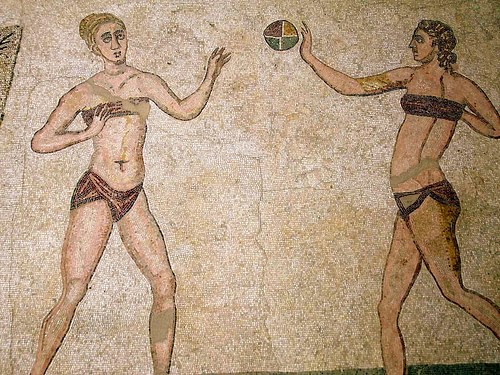
The Romans differentiated between certain cities in their new province depending on their past allegiances, and some had more political freedom and less of a tax burden than others but, generally, with the Roman concern to guarantee a reliable grain supply, the island prospered into the imperial period and Greek and Latin cultures co-existed. Augustus created several colonies for veterans on the island and agriculture flourished with the establishment of many large, imperial estates, so that Sicily became an important producer of wine, wool and timber. Over time Sicily's importance to Rome waned, but Syracuse did become an important Christian centre and remained one right up to the 7th century CE.