Zeus was the king of the 12 Olympian gods and the supreme god in Greek religion. Zeus is often referred to as the Father, as the god of thunder, and the 'cloud-gatherer'. Zeus controlled the weather and offered signs and omens. Zeus generally dispensed justice, guaranteeing order amongst both the gods and humanity from his seat high on Mt. Olympus.
Zeus & Cronus
Zeus' father was Cronus and his mother Rhea. Cronus had usurped control of the heavens from his father Ouranos and he was constantly wary of not having the same thing happen to him from his own children. To pre-empt any takeover he, therefore, swallowed all of his children: Hestia, Demeter, Hera, Hades, and Poseidon. However, Rhea saved her youngest child Zeus by wrapping a stone in swaddling clothes and giving this to Cronus to swallow. Zeus was spirited away to Mt. Dikte on the island of Crete where he was raised by the primeval goddess Gaia (Earth), or in some versions by the Nymphs. Amongst these was the Nymph Amaltheia (in some versions of the myth she was a goat) who suckled the young god.
Zeus Fights the Titans & Giants
On reaching adulthood Zeus made Cronus cough back up the children he had swallowed and Zeus then married his sister Hera. However, the lawless Titans, encouraged by Gaia, immediately tried to wrestle control of the world from the Olympian gods in a ten-year battle known as the Titanomachy. The Titans were the brothers and sisters of Cronus and it was only through the help of the Cyclopes - who made Zeus his lightning bolts - and the hundred-handed giants or Hecatoncheires (Briareos, Cottus and Gyges) that Zeus was finally able to imprison the Titans in Tartarus, the deepest part of the Underworld. Making himself ruler of the skies, Zeus then gave dominion over the seas to Poseidon and of the Underworld to Hades.
The Olympians still could not reign peacefully, though, for Gaia then enlisted the help of the terrible and savage Giants to battle with Zeus in the Gigantomachy. The Olympians were this time helped by the great hero Hercules and, after Zeus outwitted Gaia in her attempt to give the giants a magic herb, they once again won the battle for control of the world, not, however, before the Giants had created great destruction by moving mountains, islands and rivers.
Zeus's reign was only once more challenged when some of the gods, notably Hera, Athena and Poseidon, tried to takeover Zeus' role as head of the Olympian gods and bound him to his bed. The Father was, however, freed by one of the Hecatoncheires and the status quo restored.
Who were Zeus' Children?
Although first married (briefly it seems) to the Titan Metis and then married to Hera, Zeus was infamous in Greek mythology for his adulterous affairs, during which he often used his magical power to transform himself into various incarnations to bed his prey. He, therefore, had many offspring:
- Hephaistos, Ares, Hebe, Eileithyia - with Hera.
- Athena - with Metis but as Zeus swallowed his wife in fear a son would usurp his position, Athena was born from Zeus' head and she became the god's favourite child.
- Apollo & Artemis - with Leto.
- Hermes - with the Nymph Maia. Zeus, impressed by his trickery and silver tongue, gave him the role of messenger of the gods.
- Dionysos - with Semele who, being tricked by a jealous Hera, asked to see Zeus in all his godly splendour and immediately expired as a consequence. Dionysos was born from Zeus' thigh as a result of his mother's premature death.
- Hercules - with Alkmene and he was, therefore, forever the subject of a jealous Hera's scheming but on his death Zeus brought him to Mt. Olympus and made him into a god.
- Perseus - with Danae, who was won over to the charms of Zeus when he appeared to her as golden rain in order to enter her chamber where she was imprisoned by her father Acrisius.
- Persephone & Iacchus- with Demeter.
- The Fates, the Hours, Horae (Seasons), Eunomia (Lawfulness), Dike (Justice), Eirene (Peace) - with Themis.
- Helen, the Dioskouroi & Polydeuces - with Leda, for whom he transformed himself into a swan.
- Aglaea (Splendour), Euphrosyne (Joy) & Thalia (Good Cheer) - (the three Graces) with Eurynome.
- Minos, Rhadamanthys & Sarpedon - with Europa after Zeus disguised himself as a magnificent white bull and whisked her off to Crete.
- Epaphos - with Io.
- Iasion - with Electra.
- Arcas - with the Nymph Callisto - both son and mother were transformed into bears by a jealous Artemis but Zeus made them into constellations - Ursa Minor and Major.
- The nine Muses - with Mnemosyne after the couple slept together for nine consecutive nights.
Zeus was also regarded as the founder of certain races, notably the Magnesians and the Macedonians. He also turned ants into the magnificent fighting Myrmidons for his son Aiakos, later to be led by Achilles in the Trojan War.
Who did Zeus Punish?
The god was also the great punisher. Those who did wrong or committed acts of impiety were severely punished, often for all time. The Titans were imprisoned in Tartarus and after acts of impiety against Zeus, Apollo and Poseidon were made to build the magnificent walls of Troy which proved so useful in the Trojan War. An explanation for the war in mythology was that Zeus sought to curb the rising population of humanity. Zeus also selected Paris as the judge in the famous beauty contest between Aphrodite, Hera and Athena, and when the young prince won Helen as his reward for choosing Aphrodite it was cited as another, more human cause for the Trojan War.
Other victims of Zeus' vengeance included The Titan Prometheus who was condemned to have his liver eaten by an eagle every day after he stole fire from the gods and gave it to humankind. Atlas had to support the heavens for eternity because of his role in the Titanomachy. Sisyphus, punished for his trickery, was condemned to forever roll a huge stone up a hill in the Underworld. Asclepius was killed by one of Zeus' thunderbolts because the former's medicine and his ability to raise the dead threatened the balance of power between men and gods. Pandora, the first woman was sent into the world by Zeus as punishment for receiving the gift of fire and she was to be the source of all mankind's misfortunes, carried with her in a box. Phineus, who was tricked by Hera into blinding his two sons, was himself blinded by Zeus who also sent the Harpies to continuously harass him. Ixion rashly declared his love for Hera and so Zeus banished him to Hades to be forever bound to a rotating wheel. Lycaon gave human flesh to Zeus to test his divinity and the god punished his impudence by turning him into a wolf. Salmoneus thought he was a god and pretended to be Zeus by throwing flaming torches for lightning bolts and riding his chariot to make a noise like thunder but Zeus swiftly put a stop to his antics by killing him instantly with a real bolt of lightning. The list goes on but the message is clear, wrong-doing and lack of respect would be severely punished.
Zeus the Peacemaker
Despite the terrible punishments Zeus could inflict he was also a peacemaker, famously reconciling Apollo and Hermes when they fought over the first lyre. Similarly, Zeus resolved the conflict between Apollo and Hercules over the tripod from Delphi. He also persuaded Hades to part with Persephone for part of each year and so end the terrible drought her mother Demeter had caused for the human race in protest at being held captive in the Underworld. For mere mortals, Zeus was at least fair-minded. At his feet Zeus had the jars of Fate - one full of bad things, another full of good things and he dispensed both with justice. Similarly, the time of a mortal's death was carefully weighed in Zeus' golden scales.
Sites Sacred to Zeus
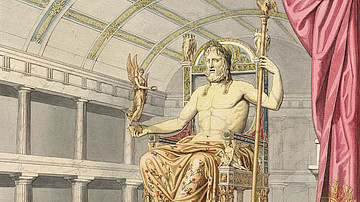
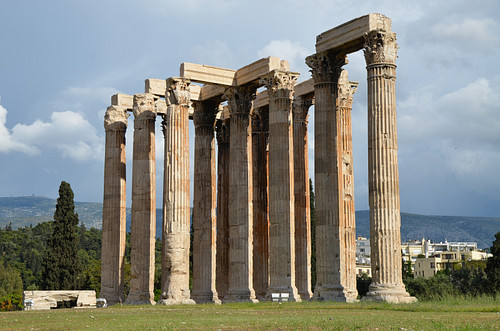
As a major figure in the Greek religion, Zeus had an oracle, the oldest in fact, at Dodona in northern Greece where ascetic priests served an oracle which interpreted the sounds from the wind in the branches of the sacred oak trees and the babbling of water from the holy spring. Another great sanctuary dedicated to Zeus was at Olympia where every four years from 776 BCE the Olympic Games drew crowds from all parts of the Greek world to honour the father of the gods and where 100 oxen were sacrificed to Zeus at the end of each Games. Also at Olympia, the massive 5th century BCE temple of Zeus housed the gigantic gold and ivory statue of the god by Pheidias which was one of the Seven Wonders of the ancient world. Other important sacred sites for the god were on Mt. Lycaios, in Athens, Nemea, Pergamon, Stratos, and in Libya.
There were surprisingly few festivals in honour of Zeus, one was the Diasia of Athens. Generally, though, Zeus, as head of the Greek pantheon, was omnipresent and so made no particular attachments to specific cities. Zeus was, however, worshipped in most family homes where an altar was often dedicated to him in each courtyard, for as Zeus Herkeios, he protected the family hearth and property in general. He was also Zeus Xenios, the god of hospitality, Zeus Polieus, protector of cities, Zeus Horkios guardian of oaths and Zeus Soter, the protector and general benefactor to all.
How Was Zeus Represented in Art?
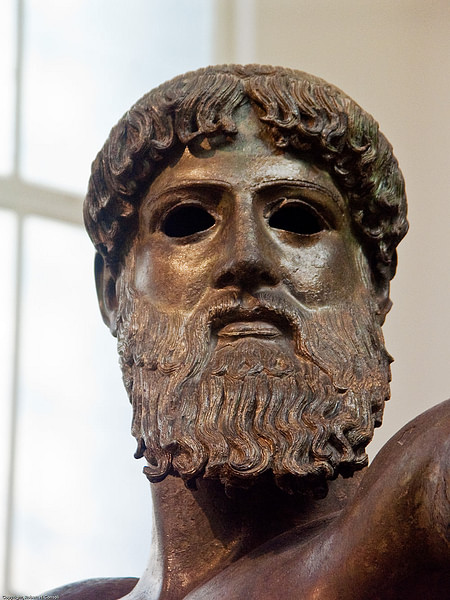
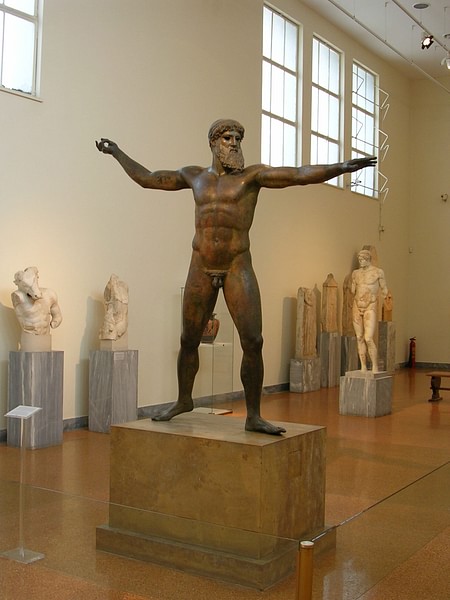
In Greek art Zeus is almost always bearded and carries either a lightning bolt or sceptre. He was also strongly associated with bulls, oak trees and eagles, one of the latter sometimes appears at his side when he does not have his lightning bolt or sceptre. Zeus is a central figure in the east pediment of the Parthenon but without doubt the most majestic representation of the god is the bronze statue from Artemesium (460 BCE) where he confidently stands, feet wide apart, about to launch a thunderbolt.
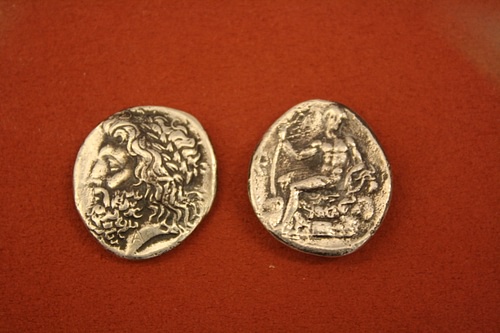
Some scholars believe the figure is Poseidon but the art historian J.Boardman presents the convincing argument that the stance is much more familiar to representations of Zeus in Greek art (see the Dodona statue) and if the figure held a trident (much longer than a thunderbolt) it would obscure the face, an undesirable aesthetic consequence for Greek sculpture. Greek pottery is another rich source of the myths involving Zeus, in particular scenes representing his many metamorphoses and Zeus also appeared on many coins, notably those of Elis.