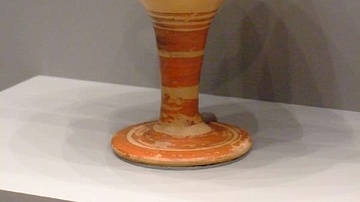
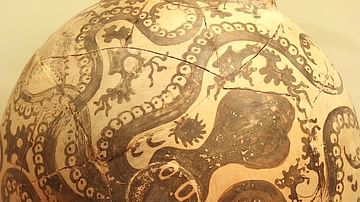
Greece is a country in southeastern Europe, known in Greek as Hellas or Ellada, and consisting of a mainland and an archipelago of islands. Ancient Greece is the birthplace of Western philosophy (Socrates, Plato, and Aristotle), literature (Homer and Hesiod), mathematics (Pythagoras and Euclid), history (Herodotus), drama (Sophocles, Euripides, and Aristophanes), the Olympic Games, and democracy.
The concept of an atomic universe was first posited in Greece through the work of Democritus and Leucippus. The process of today's scientific method was first introduced through the work of Thales of Miletus and those who followed him. The Latin alphabet also comes from ancient Greece, having been introduced to the region during the Phoenician colonization in the 8th century BCE, and early work in physics and engineering was pioneered by Archimedes, of the Greek colony of Syracuse, among others.
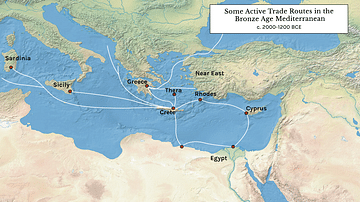
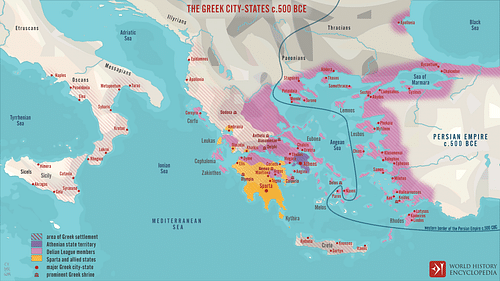
Mainland Greece is a large peninsula surrounded on three sides by the Mediterranean Sea (branching into the Ionian Sea in the west and the Aegean Sea in the east) which also comprises the islands known as the Cyclades and the Dodecanese (including Rhodes), the Ionian islands (including Corcyra), the isle of Crete, and the southern peninsula known as the Peloponnese.
The Greeks became skilled seafaring people & traders who built some of the most impressive structures in antiquity.
The geography of Greece greatly influenced the culture in that, with few natural resources and surrounded by water, the people eventually took to the sea for their livelihood. Mountains cover 80 percent of Greece and only small rivers run through a rocky landscape which, for the most part, provides little encouragement for agriculture. Consequently, the early ancient Greeks colonized neighboring islands and founded settlements along the coast of Anatolia (also known as Asia Minor, modern-day Turkey). The Greeks became skilled seafaring people and traders who, possessing an abundance of raw materials for construction in stone, and great skill, built some of the most impressive structures in antiquity.
The designation Hellas derives from Hellen, the son of Deucalion and Pyrrha who feature prominently in Ovid's tale of the Great Flood in his Metamorphoses. The mythical Deucalion (son of the fire-bringing titan Prometheus) was the savior of the human race from the Great Flood, in the same way Noah is presented in the biblical version or Utnapishtim in the Mesopotamian one. Deucalion and Pyrrha repopulate the land once the floodwaters have receded by casting stones which become people, the first being Hellen. Contrary to popular opinion, Hellas and Ellada have nothing to do with Helen of Troy from Homer's Iliad. Ovid, however, did not coin the designation. Thucydides writes, in Book I of his Histories:
I am inclined to think that the very name was not as yet given to the whole country, and in fact did not exist at all before the time of Hellen, the son of Deucalion; the different tribes, of which the Pelasgian was the most widely spread, gave their own names to different districts. But when Hellen and his sons became powerful in Phthiotis, their aid was invoked by other cities, and those who associated with them gradually began to be called Hellenes, though a long time elapsed before the name was prevalent over the whole country. Of this, Homer affords the best evidence; for he, although he lived long after the Trojan War, nowhere uses this name collectively, but confines it to the followers of Achilles from Phthiotis, who were the original Hellenes; when speaking of the entire host, he calls them Danäans, or Argives, or Achaeans.
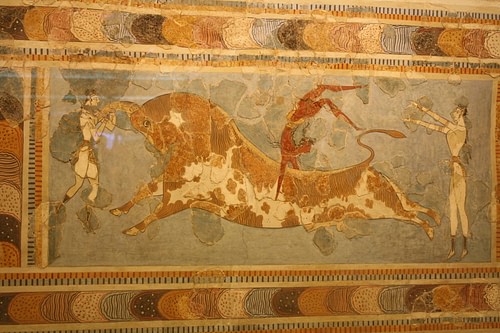
Minoan Bull Leaping
Mark Cartwright (CC BY-NC-SA)
Early History of Ancient Greece
Ancient Greek history is most easily understood by dividing it into time periods. The region was already settled, and agriculture initiated, during the Paleolithic era as evidenced by finds at Petralona and Franchthi caves (two of the oldest human habitations in the world). The Neolithic Age (c. 6000 - c. 2900 BCE) is characterized by permanent settlements (primarily in northern Greece), domestication of animals, and the further development of agriculture. Archaeological finds in northern Greece (Thessaly, Macedonia, and Sesklo, among others) suggest a migration from Anatolia in that the ceramic cups and bowls and figures found there share qualities distinctive to Neolithic finds in Anatolia. These inland settlers were primarily farmers, as northern Greece was more conducive to agriculture than elsewhere in the region, and lived in one-room stone houses with a roof of timber and clay daubing.
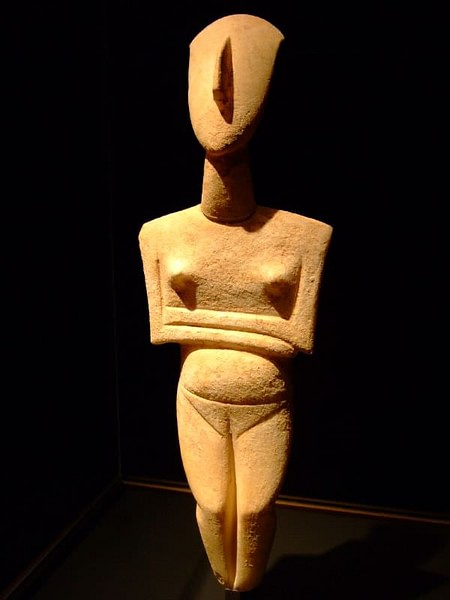
The Cycladic Civilization (c. 3200-1100 BCE) flourished in the islands of the Aegean Sea (including Delos, Naxos, and Paros) and provides the earliest evidence of continual human habitation in that region. During the Cycladic Period, houses and temples were built of finished stone and the people made their living through fishing and trade. This period is usually divided into three phases: Early Cycladic, Middle Cycladic, and Late Cycladic with a steady development in art and architecture. The latter two phases overlap and finally merge with the Minoan Civilization, and differences between the periods become indistinguishable.
Cycladic Figurine c. 2400 BCE
Mary Harrsch (Photographed at the Getty Villa, Malibu) (CC BY-NC-SA)
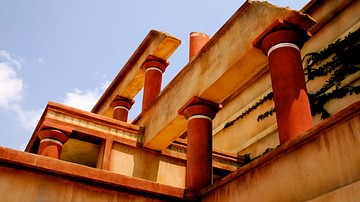
The Minoan Civilization (2700-1500 BCE) developed on the island of Crete, and rapidly became the dominant sea power in the region. The term 'Minoan' was coined by the archaeologist Sir Arthur Evans, who uncovered the Minoan palace of Knossos in 1900 CE and named the culture for the ancient Cretan king Minos. The name by which the people knew themselves is not known. The Minoan Civilization was thriving, as the Cycladic Civilization seems to have been, long before the accepted modern dates which mark its existence and probably earlier than 6000 BCE.
The Minoans developed a writing system known as Linear A (which has not yet been deciphered) and made advances in shipbuilding, construction, ceramics, the arts and sciences, and warfare. King Minos was credited by ancient historians (Thucydides among them) as being the first person to establish a navy with which he colonized, or conquered, the Cyclades. Archaeological and geological evidence on Crete suggests this civilization fell due to an overuse of the land causing deforestation though, traditionally, it is accepted that they were conquered by the Mycenaeans. The eruption of the volcano on the nearby island of Thera (modern-day Santorini) between 1650 and 1550 BCE and the resulting tsunami is acknowledged as the final cause for the fall of the Minoans. The isle of Crete was deluged and the cities and villages destroyed. This event has been frequently cited as Plato's inspiration in creating his myth of Atlantis in his dialogues of the Critias and Timaeus.
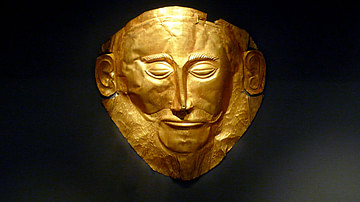
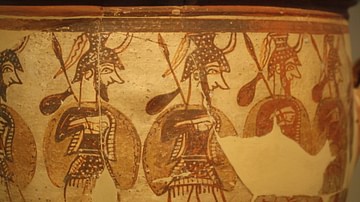
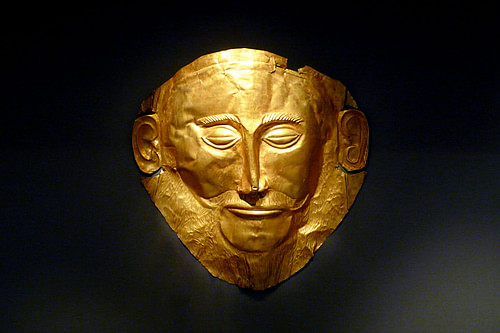
The Mycenaean Civilization (approximately 1900-1100 BCE) is commonly acknowledged as the beginning of Greek culture, even though we know almost nothing about the Mycenaeans save what can be determined through archaeological finds and through Homer's account of their war with Troy as recorded in the Iliad. They are credited with establishing the culture owing primarily to their architectural advances, their development of a writing system (known as Linear B, an early form of Greek descended from the Minoan Linear A), and the establishment, or enhancement of, religious rites. The Mycenaeans appear to have been greatly influenced by the Minoans of Crete in their worship of earth goddesses and sky gods, which, in time, become the classical Greek pantheon.
Death Mask of Agamemnon
Xuan Che (CC BY)
Greek mythology provided a solid paradigm of the creation of the universe, the world, and human beings. An early myth relates how, in the beginning, there was nothing but chaos in the form of unending waters. From this chaos came the goddess Eurynome who separated the water from the air and began her dance of creation with the serpent Ophion. From their dance, all of creation sprang and Eurynome was, originally, the Great Mother Goddess and Creator of All Things.
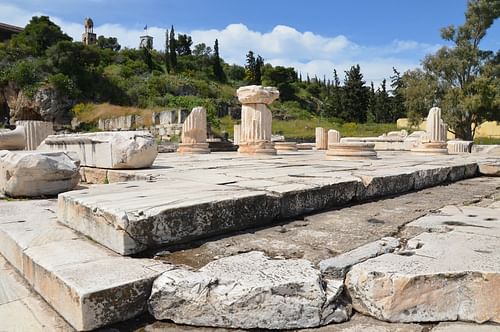
By the time Hesiod and Homer were writing (8th century BCE), this story had changed into the more familiar myth concerning the titans, Zeus' war against them, and the birth of the Olympian Gods with Zeus as their chief. This shift indicates a movement from a matriarchal religion to a patriarchal paradigm. Whichever model was followed, however, the gods clearly interacted regularly with the humans who worshipped them and were a large part of daily life in ancient Greece. Prior to the coming of the Romans, the only road in mainland Greece that was not a cow path was the Sacred Way which ran between the city of Athens and the holy city of Eleusis, the birthplace of the Eleusinian Mysteries celebrating the goddess Demeter and her daughter Persephone.
By 1100 BCE, around the time of the Bronze Age Collapse, the great Mycenaean cities of southwest Greece were abandoned and, some claim, their civilization destroyed by an invasion of Doric Greeks. Archaeological evidence is inconclusive as to what led to the fall of the Mycenaeans. As no written records of this period survive (or have yet to be unearthed) one may only speculate on causes. The tablets of Linear B script found thus far contain only lists of goods bartered in trade or kept in stock. It seems clear, however, that after what is known as the Greek Dark Ages (approximately 1100-800 BCE, so named because of the absence of written documentation) Greek colonization was ongoing in much of Asia Minor, and the islands surrounding mainland Greece and began to make significant cultural advances. Beginning in c. 585 BCE the first Greek philosopher, Thales of Miletus, was engaged in what, today, would be recognized as scientific inquiry on the Asia Minor coast, and this region of Ionian colonies would make significant breakthroughs in Greek philosophy and mathematics.
From the Archaic to the Classical Periods
Greece reached the heights in almost every area of human learning during the Classical Period.
The Archaic Period (800-500 BCE) is characterized by the introduction of republics instead of monarchies (which, in Athens, moved toward democratic rule) organized as a single city-state or polis, the institution of laws (Draco's reforms in Athens), the great Panathenaic Festival was established, distinctive Greek pottery and Greek sculpture were born, and the first coins minted on the island kingdom of Aegina. This, then, set the stage for the flourishing of the Classical Period of ancient Greece given as 500-400 BCE or, more precisely, as 480-323 BCE, from the Greek victory at the Battle of Salamis to the death of Alexander the Great. This was the Golden Age of Athens, when Pericles initiated the building of the Acropolis and spoke his famous eulogy for the men who died defending Greece at the Battle of Marathon in 490 BCE. Greece reached the heights in almost every area of human learning during this time and the great thinkers and artists of antiquity (Phidias, Plato, Aristophanes, to mention only three) flourished. Leonidas and his 300 Spartans fell at Thermopylae and, the same year (480 BCE), Themistocles won victory over the superior Persian naval fleet at Salamis leading to the final defeat of the Persians at the Battle of Plataea in 479 BCE.
Democracy (literally Demos = people and Kratos = power, so power of the people) was established in Athens allowing all male citizens over the age of twenty a voice in the Greek government. The Pre-Socratic philosophers, following Thales' lead, initiated what would become the scientific method in exploring natural phenomena. Men like Anaximander, Anaximenes, Pythagoras, Democritus, Xenophanes, and Heraclitus abandoned the theistic model of the universe and strove to uncover the underlying, first cause of life and the universe.
Love History?
Sign up for our free weekly email newsletter!
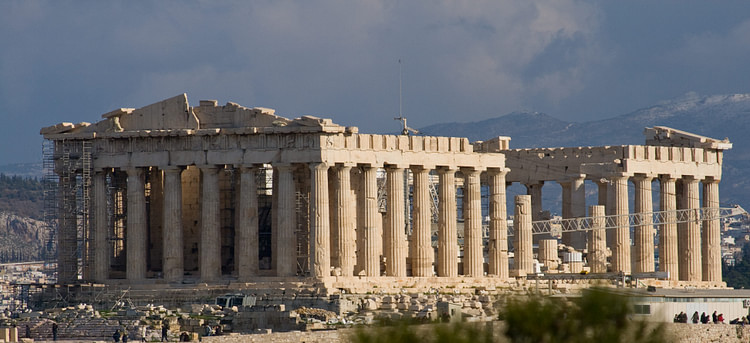
Their successors, among whom were Euclid and Archimedes, continued to advance Greek science and philosophical inquiry and further established mathematics as a serious discipline. The example of Socrates and the writings of Plato and Aristotle after him have influenced western culture and society for over two thousand years. This period also saw advances in architecture and art with a movement away from the ideal to the realistic. Famous works of Greek sculpture such as the Parthenon Marbles and Discobolos (the discus thrower) date from this time and epitomize the artist's interest in depicting human emotion, beauty, and accomplishment realistically, even if those qualities are presented in works featuring immortals.
The Parthenon
Andrew Griffith (CC BY-NC-SA)
All of these developments in culture were made possible by the ascent of Athens following the victory over the Persians in 480 BCE. The peace and prosperity which followed the Persian defeat provided the finances and stability for culture to flourish. Athens became the superpower of the day and, with the most powerful navy, was able to demand tribute from other city-states and enforce its wishes. Athens formed the Delian League, a defensive alliance whose stated purpose was to deter the Persians from further hostilities.
The city-state of Sparta, however, doubted Athenian sincerity and formed their own association for protection against their enemies, the Peloponnesian League (so named for the Peloponnese region where Sparta and the others were located). The city-states which sided with Sparta increasingly perceived Athens as a bully and a tyrant, while those cities which sided with Athens viewed Sparta and its allies with growing distrust. The tension between these two parties eventually erupted in what has become known as the Peloponnesian Wars. The first conflict (c. 460-445 BCE) ended in a truce and continued prosperity for both parties while the second (431-404 BCE) left Athens in ruins and Sparta, the victor, bankrupt after her protracted war with Thebes.
This time is generally referred to as the Late Classical Period (c. 400-330 BCE). The power vacuum left by the fall of these two cities was filled by Philip II of Macedon (382-336 BCE) after his victory over the Athenian forces and their allies at the Battle of Chaeronea in 338 BCE. Philip united the Greek city-states under Macedonian rule and, upon his assassination in 336 BCE, his son Alexander assumed the throne.
Alexander the Great & the Coming of Rome
Alexander the Great (356-323 BCE) carried on his father's plans for a full scale invasion of Persia in retaliation for their invasion of Greece in 480 BCE. As he had almost the whole of Greece under his command, a standing army of considerable size and strength, and a full treasury, Alexander did not need to bother with allies nor with consulting anyone regarding his plan for invasion and so led his army into Egypt, across Asia Minor, through Persia, and finally to India. Tutored in his youth by Plato's great student Aristotle, Alexander would spread the ideals of Greek civilization through his conquests and, in so doing, transmitted Greek art, philosophy, culture, and language to every region he came in contact with.
Alexander the Great [Profile View]
Egisto Sani (CC BY-NC-SA)
In 323 BCE Alexander died and his vast empire was divided between four of his generals. This initiated what has come to be known to historians as the Hellenistic Period (323-31 BCE) during which Greek thought and culture became dominant in the various regions under these generals' influence. After the wars of the Diadochi ('the successors' as Alexander's generals came to be known), Antigonus I established the Antigonid Dynasty in Greece which he then lost. It was regained by his grandson, Antigonus II Gonatas, by 276 BCE who ruled the country from his palace at Macedon.
The Roman Republic became increasingly involved in the affairs of Greece during this time and, in 168 BCE, defeated Macedon at the Battle of Pydna. After this date, Greece steadily came under the influence of Rome. In 146 BCE, the region was designated a Protectorate of Rome and Romans began to emulate Greek fashion, philosophy and, to a certain extent, sensibilities. In 31 BCE Octavian Caesar annexed the country as a province of Rome following his victory over Mark Antony and Cleopatra at the Battle of Actium. Octavian became Augustus Caesar and Greece a part of the Roman Empire.
Editorial Review
This article has been reviewed by our editorial team before publication to ensure accuracy, reliability and adherence to academic standards in accordance with our editorial policy.
Joshua J. Mark is World History Encyclopedia's co-founder and Content Director. He was previously a professor at Marist College (NY) where he taught history, philosophy, literature, and writing. He has traveled extensively and lived in Greece and Germany.
World History Encyclopedia is a non-profit organization. For only $5 per month you can become a member and support our mission to engage people with cultural heritage and to improve history education worldwide.
Mark, J. J. (2013, November 13). Ancient Greece.
World History Encyclopedia. Retrieved from https://www.worldhistory.org/greece/
Chicago Style
Mark, Joshua J.. "Ancient Greece."
World History Encyclopedia. Last modified November 13, 2013.
https://www.worldhistory.org/greece/.
MLA Style
Mark, Joshua J.. "Ancient Greece."
World History Encyclopedia. World History Encyclopedia, 13 Nov 2013. Web. 25 Apr 2024.
License & Copyright
Submitted by Joshua J. Mark, published on 13 November 2013. The copyright holder has published this content under the following license: Creative Commons Attribution-NonCommercial-ShareAlike. This license lets others remix, tweak, and build upon this content non-commercially, as long as they credit the author and license their new creations under the identical terms. When republishing on the web a hyperlink back to the original content source URL must be included. Please note that content linked from this page may have different licensing terms.


![Alexander the Great [Profile View]](https://www.worldhistory.org/img/r/p/500x600/1047.jpg?v=1660133770)