Alexandria is a port city on the Mediterranean Sea in northern Egypt founded in 331 BCE by Alexander the Great. It was the site of the Pharos (lighthouse), one of the seven wonders of the ancient world, and the legendary Library of Alexandria and was once the most vital cultural center of the ancient world, rivaling even Athens, Greece.
The city developed from a small port known as Rhakotis after the arrival of Alexander, who laid out the basic design for what he wanted and then left to continue his conquest of Persia. The city was further developed under the Ptolemaic Dynasty (323-30 BCE) into an intellectual, cultural, and commercial hub, one of the greatest cities of its time, and would later become famous as a center of early Christianity.
It also became infamous for the religious strife which resulted from the clash of pagan, Jewish, and Christian faiths after the rise of Christianity in the 4th and 5th centuries. Among the most notable events of this period is the martyrdom of the Neo-Platonic philosopher Hypatia of Alexandria in 415, which many modern-day scholars cite as a pivotal event in the decline of intellectual pursuits in the city.
By the time Christianity became the dominant faith, pagan sites such as the Mouseion, the Temple of Serapis, and the Serapion – all associated in one way or another with the Library of Alexandria – were already in decline. These institutions relied on the patronage of the Ptolemies and, as that steadily fell off toward the end of the Ptolemaic Dynasty, the buildings could not be maintained, and neither could the scholars who copied, cared for, and cataloged the manuscripts. Even though later Roman emperors seem to have patronized the library, it does not seem to have been at the same level as the Ptolemies.
As religious division increased in the city in the early 5th century, intellectuals left to find work in more stable areas. Religious conflict continued through the 7th century when the Muslim Arabs conquered the region and, by that time, the once great metropolis of Alexandria was a memory.
Foundation By Alexander
After conquering Syria in 332 BCE, Alexander the Great swept down into Egypt with his army. He founded Alexandria in the small port town of Rhakotis by the sea with the intention of creating a commercial center superior to the Greek city of Naucratis (an important trade center), which was further inland on the Nile Delta. It is said that he designed the plan for the city by pouring flour or grain out in a grid pattern which was then adopted by his architect. The city that developed from this rudimentary model was greatly admired by many, including the historian and geographer Strabo (l. c. 64 BCE to 24 CE), who describes it in detail:
The shape of the plan of the city is like a chlamys [a military cloak]. The long sides are those washed by the water – having a diameter of about 30 stadia – and the short ones are the isthmuses, each of 7 or 8 stadia, that are pressed together by the sea on one [side] and the lake on the other. As a whole, it is cut up by streets that are suitable for riding horses and driving chariots. Two of them are exceedingly wide – spread out more than a plethron – which cut each other into two at right angles. The city has the most beautiful precincts and royal palaces, which are a fourth or third part of the entire circuit. Each of the kings, from a love of splendor, made some adornment to the public monuments, and would also expand his own residence in addition to what already existed, so that today (with the Poet), "there is another on another" [Odyssey 17.266]. Everything is connected with one another, the harbor, or what is outside it. The Mouseion is part of the palaces, with a walkway, an exedra, and a large structure in which there is the common mess of the scholarly men who share the Mouseion, once appointed by the kings but now by Caesar.
(Geography, 17.1.8)
The Mouseion was an institute of higher learning, which was part of the Library of Alexandria. It was dedicated to the Muses (its name is the origin of the English word 'museum') and established, probably by Ptolemy II (r. 282-246 BCE), as a gathering place and home for scholars whose works contributed to the holdings of the library.
The palaces and grand homes Strabo mentions did not exist at the time Alexander founded the city, of course. He left Egypt only a few months after his arrival to march on Tyre in Phoenicia. It was left to his commander, Cleomenes of Naucratis (d. 322 BCE) to build the city based on the plans of the architect Dinocrates of Rhodes who, allegedly following Alexander's plan, laid the city out in the pattern known as the Hippodamian Grid Plan – formulated by the architect Hippodamus of Miletus (l. 5th century BCE) and considered the optimal design for urban planning.

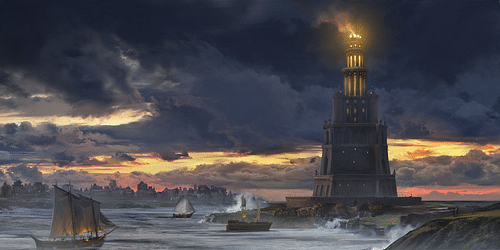
Although Cleomenes and Dinocrates established the layout of the city, the full expansion of Alexandria came under the rule of Alexander's general Ptolemy and the rule of the Ptolemaic Dynasty which followed. After Alexander's death in 323 BCE, Ptolemy brought his body back to Alexandria to be entombed and, during the Wars of the Diadochi (Alexander's successors), began rule of Egypt from Alexandria, supplanting the old capital of Memphis. Under Ptolemy II, the Lighthouse of Alexandria, one the seven wonders of the ancient world, was completed (where the 15th-century Fort Qaitbey stands today).
The lighthouse guided ships into the harbors which had also been designed by Alexander the Great. Tyre had been an important city for trade and commerce in the region and, after its destruction by Alexander, Alexandria filled the void which had been left. Carthage (which also prospered owing to the sack of Tyre) was still a young port town when Alexandria began to thrive. Scholar M. Mangasarian comments:
Under the Ptolemies, a line of Greek kings, Alexandria soon sprang into eminence, and, accumulating culture and wealth, became the most powerful metropolis of the Orient. Serving as the port of Europe, it attracted the lucrative trade of India and Arabia. Its markets were enriched with the gorgeous silks and fabrics from the bazaars of the Orient. Wealth brought leisure, and it, in turn, the arts. It became, in time, the home of a wonderful library and schools of philosophy, representing all the phases and the most delicate shades of thought. At one time it was the general belief that the mantle of Athens had fallen upon the shoulders of Alexandria. (5)
The city grew to become the largest in the known world at the time, attracting scholars, scientists, philosophers, mathematicians, artists, and historians. The poet and scholar Callimachus of Cyrene (l. c. 310 to c. 240 BCE) cataloged the entirety of Greek literature at Alexandria using the collection housed in the library and is credited with creating the first 'card catalog' to systematically organize that collection. Eratosthenes (l. c. 276-195 BCE) calculated the circumference of the earth to within 80 kilometers (50 mi) at Alexandria. Euclid (l. c. 300 BCE) taught at the university there. Archimedes (l. 287-212 BCE), the great mathematician and astronomer, may have taught there and certainly studied there. The greatest engineer and mathematician of his day, Hero (also known as Heron, l. 10-70), was born and lived in Alexandria. Hero was credited with amazing feats in engineering and technology including the first vending machine, the force-pump, and a theatre of automated figures who danced, among his other inventions.
The Library of Alexandria
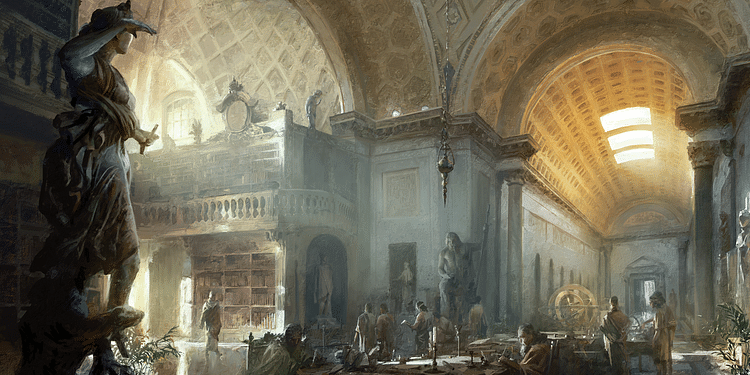
The library, begun under Ptolemy I (r. 323-282 BCE) was completed by Ptolemy II who sent invitations to rulers and scholars asking them to contribute books. According to scholars Oakes and Gahlin:
There was room for up to 70,000 papyrus scrolls. Most of the items were bought but other means were sometimes used. In order to procure coveted works, all ships entering the harbour were searched. Every book found was taken to the library where it was decided whether to give it back or confiscate it and replace it with a copy. (230)
No one knows how many books were held in the library at Alexandria, but estimates have been made of 500,000 (thought by most modern-day scholars to be an exaggeration). It is said that Mark Antony gave Cleopatra 200,000 books for the library, but this claim has been disputed since antiquity. The library seems to have been a part of the Mouseion, which was close by, or attached to the grand cluster of buildings that included the Serapion, the temple of the god Serapis, a hybrid of Greek and Egyptian deities, created by the Ptolemies to blend the diverse cultures into a harmonious union. Mangasarian describes the temple:
After its magnificent library, whose shelves supported a freight more precious than beaten gold, perhaps the most stupendous edifice in the town was the temple of Serapis. It is said that the builders of the famous temple of Edessa boasted that they had succeeded in creating something which future generations would compare with the temple of Serapis in Alexandria. This ought to suggest an idea of the vastness and beauty of the Alexandrian Serapis, and the high esteem in which it was held. Historians and connoisseurs claim it was one of the grandest monuments of Pagan civilization, second only to the temple of Jupiter in Rome, and the inimitable Parthenon in Athens. The Serapis temple was built upon an artificial hill, the ascent to which was by a hundred steps. It was not one building, but a vast body of buildings, all grouped about a central one of vaster dimensions, rising on pillars of huge magnitude and graceful proportions. Some critics have advanced the idea that the builders of this masterpiece intended to make it a composite structure, combining the diverse elements of Egyptian and Greek art into a harmonious whole. The Serapion was regarded by the ancients as marking the reconciliation between the architects of the pyramids and the creators of the Athenian Acropolis. It represented to their minds the blending of the massive in Egyptian art with the grace and the loveliness of the Hellenic. (6)
When Carthage rose to the height of its power, Alexandria was relatively unaffected as trade had long been established and the city posed no threat to the sea power of the Carthaginians. Even after the fall of Carthage following the Punic Wars (264-146 BCE), when Rome became the superpower of the Mediterranean, the city remained prosperous and continued to attract visitors from all over the world.
The civil war between the Roman generals Julius Caesar and Pompey first impacted Alexandria negatively in 48 BCE. Prior to this date, though the city certainly experienced its share of problems, it remained a stable environment. Following the Battle of Pharsalus, however, at which Caesar defeated Pompey, Pompey fled to Alexandria seeking sanctuary and was killed by the co-regent Ptolemy XIII.
Caesar arrived and, whether real or feigned, claimed outrage at the death of his former friend and ally. He then declared martial law, took over the royal palace, and sent for the exiled co-regent Cleopatra VII. In the civil war which ensued between Caesar and the forces of Ptolemy XIII, much of the port area of Alexandria was burned, including, according to some scholars, the famous library. It seems, however, that only a storehouse of manuscripts located near the harbor was burned, not the library itself. As with much of the information concerning the famous library, this claim has been and continues to be challenged.
Roman Alexandria
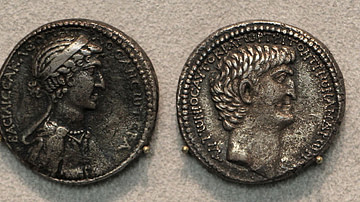
Following Caesar's assassination in 44 BCE, his right-hand man, Marcus Antonius (Mark Antony) became Cleopatra's consort and left Rome for Alexandria. The city became his base of operations over the next 13 years until he and Cleopatra were defeated by Octavian Caesar at the Battle of Actium in 31 BCE. The next year, Cleopatra and Antony both committed suicide, and with her death, the Ptolemaic line came to an end. Octavian became the first emperor of Rome and took the title Augustus. Alexandria now became a province of the Roman Empire under the rule of Augustus Caesar.
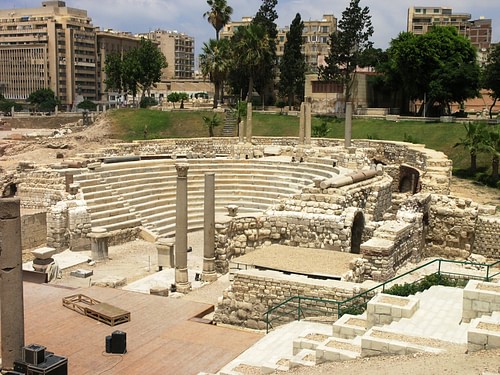
Augustus consolidated his power in the provinces and had Alexandria restored. Scholars who argue against Julius Caesar's role in the burning of the great library point to the fact that there is ample evidence it was still extant under the reign of Augustus and that visitors were still attracted to the city as a seat of learning. Alexandria was severely damaged in 115 in the Kitos War and was restored by the emperor Hadrian, who, as a man of learning and refinement, took great interest in the city. Alexandria was still an important intellectual center at this time, and the Greek Septuagint (the Greek translation of the Jewish scriptures, the Old Testament of the Bible) was completed there in 132 and is said to have taken its place among the great books of the library.
Religious scholars lived in or frequented the library for research, and Alexandria had long attracted people of many different faiths, who, initially, seem to have respected the diverse belief systems. Under Augustus' reign, however, there were disputes between Jews and pagans, and as Christianity grew in popularity, the Christians added to the public unrest. After the Roman emperor Constantine the Great (r. 306-337) passed the Edict of Milan in 313 (decreeing religious tolerance), Christians were no longer liable for prosecution under the law and began to not only demand more religious rights but press their attacks on the pagans and the Jews.
Religion & the Decline of Alexandria
Alexandria, which had been a city of prosperity and learning, became an arena of religious contention between the new faith of the Christians and the older faiths of the Jews and pagans. The Christians increasingly felt bold enough to strike at the symbols of these faiths as they believed theirs was the only true belief system. Mangasarian writes:
It is not so much religion that makes the character of a people, as it is the people who determine the character of their religion. Religion is only the resume of the national ideas, thoughts, and character. Religion is nothing but an expression. It is not, for instance, the word or the language which creates the idea, but the idea which provokes the word into existence. In the same way religion is only the expression of a people's mentality. And yet a man's religion or philosophy, while it is but the product of his own mind, exerts a reflex influence upon his character. The child influences the parent, of whom it is the offspring; language affects thought, of which, originally, it was but the tool. So it is with religion. The Christian religion, as soon as it got into power, turned the world about. (8)
Perhaps nowhere more than in Alexandria was this turnabout more apparent. Under the reign of Theodosius I (379-395), paganism was outlawed and Christianity encouraged. In 391, the Christian Patriarch Theophilus followed Theodosius' lead and had all the pagan temples in Alexandria destroyed or converted into churches. By the year 400, Alexandria was in constant religious turmoil, and in 415, this resulted in the murder of the Neo-Platonic philosopher Hypatia and, according to some scholars, the burning of the great library and the complete destruction of the Temple of Serapis. Alexandria declined after this date, with scholars, scientists, and thinkers of all disciplines leaving the city for safer locales.
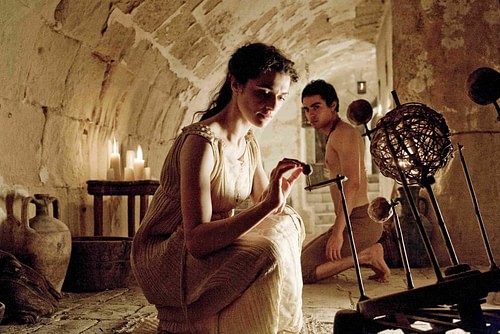
The city became steadily impoverished by civil strife, both financially and culturally, as it turned into a battlefield for warring faiths before Christianity emerged as the dominant belief system. Alexandria served as an important center of Christianity, sending missionaries throughout North Africa, and bringing the faith to other important centers like Cyrene.
Conclusion
The city was conquered by the Persians of the Sassanian Empire in 619, and then the Christian Byzantine Empire under Heraclius reclaimed the city in 628 but lost it to the invading Arab Muslims under Caliph Umar in 641. The forces of the Christian Byzantines and the Muslim Arabs then fought for control of the city and Egypt until the Arabian forces prevailed in 646 and Egypt fell under Islamic rule. The churches were now destroyed or transformed into mosques and later Christian writers claim that it was at this time that the great library was burned by the Muslim conquerors.
As with the other claims regarding the final fate of the library, this one has also been challenged and debunked. The Library at Alexandria most likely declined because it lost the patronage of the Ptolemies and later support from Rome was uneven. The papyrus scrolls and parchments were no longer cared for as before and decayed in the damp atmosphere of the city. This is not to say the library could not have fallen prey to the religious intolerance that gripped the city, but, if it did, its collection was probably either long gone or ruined by the time Caliph Umar arrived.
What was not destroyed by war was taken down by nature, and by 1326, when it was visited by the traveler and writer Ibn Battuta (l. 1304-1368/69 CE), most of Ptolemaic Alexandria was gone. The great lighthouse was destroyed by earthquakes as was much of the port. In the present day, the old city lies beneath the new or at the bottom of the harbor. In 1994, the first discoveries were made known of several relics, statuary, and buildings in the harbor of Alexandria. These have been steadily excavated by Professor Jean-Yves Empereur and his team, who continue to bring to light the lost golden age of Alexandria.