Mosaics are designs and images created using small pieces (tesserae) of stone or other materials which have been used to decorate floors, walls, ceilings, and precious objects since before written records began. Like pottery, mosaics have rarely tempted looters and so they are often found in places where everything else has long since vanished. From ancient Mesopotamia to Mesoamerica, mosaics not only reveal the artistry of civilizations but also provide an invaluable insight into what ancient peoples wore, ate, and looked like. We can see gods, myths, ritual practices, sporting activities, agricultural techniques, architecture, transport, weapons, and tools. We can even see how the world once was and glimpse now lost landscapes, flora and fauna. As even a brief overview of all the mosaics produced in all of the world's cultures is impossible, here we will look at only some example cultures and some of their most celebrated works using the mosaic technique.
Techniques
Although each culture developed its own approach to the art of making mosaics, there are many similar features which may be identified across the board. In the case of flooring, unworked stones and pebbles were used in the 3rd millennium BCE in Mesopotamia, in the Bronze Age cultures in the Near East, and by the Minoans and Mycenaeans of the Aegean.
While the Mesopotamians were covering such structures as temple columns in mosaic in the 2nd millennium BCE, geometric patterns became common in the Mediterranean from the 8th century BCE, and by around the 3rd century BCE, the now familiar small squares were being used for mosaics in the Mediterranean. Mosaic makers were eventually using just about any hard material to make the smaller and smaller pieces or tesserae with which a design was made on floors, walls, ceilings, and anything else to be covered - and the ancients did not lack imagination, deciding to employ mosaic coverings on everything from fountains in Italy to skulls in Mexico.
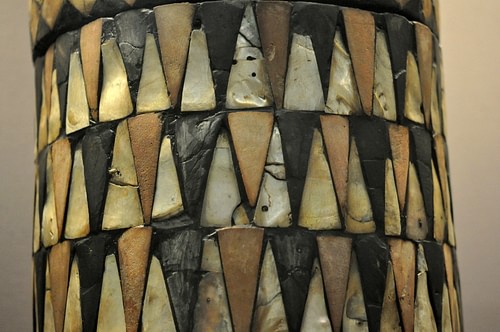
Materials included stone of all kinds (from beach pebbles to rare polished marble), shells, brick, pottery, glass, smalto (glass paste), turquoise, ivory, and jade to name a few. A base was first prepared with fresh mortar or plaster and the tesserae positioned as close together as possible with any gaps then filled with liquid mortar in a process known as grouting. This made the surface waterproof and so especially useful for humid places like Roman baths. Sometimes a double layer of mortar was used, frequently over a bed of large stones and the excavation of many mosaics has revealed that often outlines were drawn into the mortar to aid the placement of tesserae when creating a complex design. The whole mosaic was then cleaned and polished.
Greek Mosaics
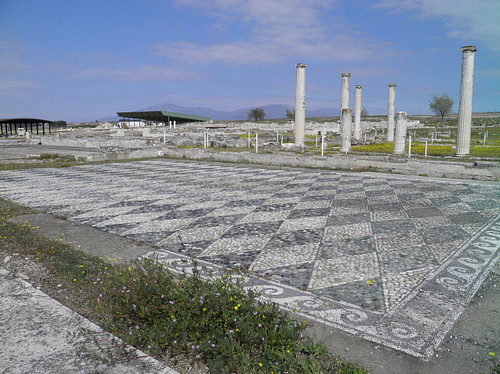
The first Greek pebble flooring which attempted designs dates to the 5th century BCE with examples at Corinth and Olynthus. These were usually in two shades with light geometric designs and simple figures on a dark background. By the end of the 4th century BCE colours were being used, and many fine examples have been found at Pella in ancient Macedon. These mosaics were often reinforced by inlaying strips of terracotta or lead, often used to mark outlines. Indeed, it was not until Hellenistic times in the 3rd century BCE that mosaics really took off as an art form and detailed panels using tesserae rather than pebbles began to be incorporated into patterned floors. Many of these mosaics attempted to copy contemporary wall paintings.
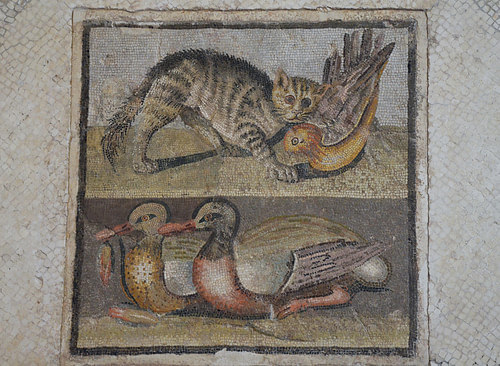
As mosaics evolved in the 2nd century BCE, ever smaller and more precisely cut tesserae were used, sometimes as small as 4 mm or less, and designs employed a wide spectrum of colours with coloured grouting to match surrounding tesserae. This particular type of mosaic which used sophisticated colouring and shading to create an effect similar to a painting is known as opus vermiculatum, and one of its greatest craftsmen was Sosus of Pergamon (150-100 BCE) whose work, especially his Drinking Doves mosaic, was much copied for centuries after. Because of the labour involved in producing these pieces, they were often small mosaics 40 x 40 cm laid on a marble tray or rimmed tray in a specialist workshop. These pieces were known as emblemata as they were often used as centrepieces for pavements with more simple designs. So valuable were these works of art that they were often removed for reuse elsewhere and handed down from generation to generation within families. Several emblemata could make up a single mosaic and gradually emblemata began to resemble more their surroundings when they are then known as panels.
Roman Mosaics
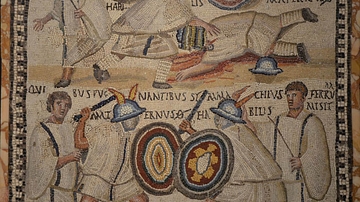
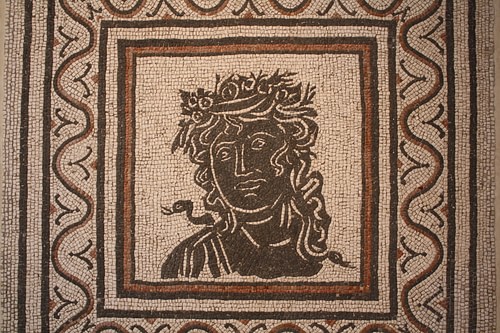
Known to the Romans as opus tessellatum, their mosaics were often made with small black, white, and coloured squares of all materials typically measuring between 0.5 and 1.5 cm, but fine details were often rendered using even smaller pieces as little as 1 mm in size. Initially, the Romans were heavily influenced by the Greek sea motifs and scenes from mythology - and the artists themselves, as the many signed Roman mosaics often bear Greek names. One of the most famous examples is the Alexander mosaic which was a copy of a Hellenistic original painting by either Philoxenus or Aristeides of Thebes. The mosaic is from the House of the Faun, Pompeii, and depicts Alexander the Great riding Bucephalus and facing Darius III on his war chariot at the Battle of Issus (333 BCE). The mosaic, now in the archaeological museum of Naples, is composed of over one million tesserae.
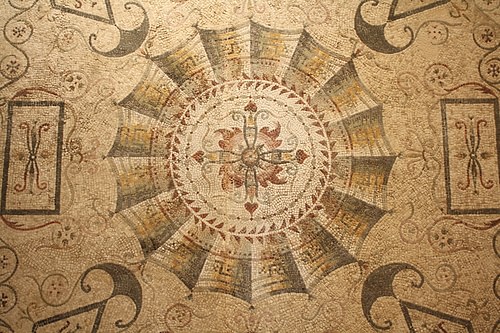
The Romans did develop their own styles, and production schools were developed across the empire which cultivated their own particular preferences - large-scale hunting scenes and attempts at perspective in the African provinces, impressionistic vegetation, and a foreground observer in the mosaics of Antioch or the European preference for figure panels, for example. The dominant (but not exclusive) Roman style in Italy itself used only black and white tesserae, a taste which survived well into the 3rd century CE and was especially used in Roman baths (those from the first floor of the Baths of Caracalla in Rome are an excellent example). There was also a preference for more two-dimensional representations and an emphasis on geometric designs. In c. 115 CE at the Baths of Buticosus in Ostia, there is the earliest example of a human figure in mosaic, and in the 2nd century CE, silhouetted figures became common. Over time the mosaics became ever more realistic in their portrayal of human figures, and accurate and detailed portraits become more common.
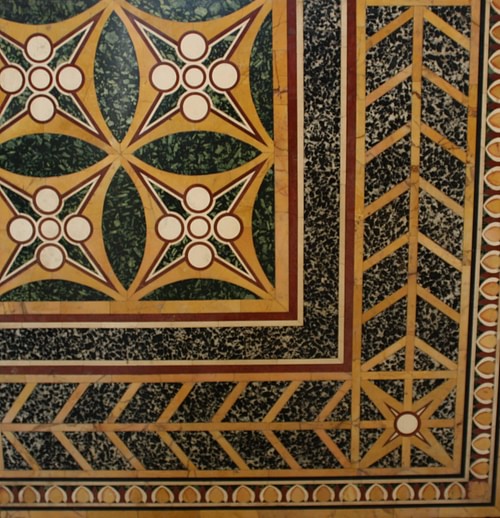
Roman floors could also be laid using larger pieces to create designs on a grander scale. Opus signinum flooring used coloured mortar aggregate (usually red) with white tesserae placed to create broad patterns or even scattered randomly. Opus sectile was a second type of flooring which used large coloured stone or marble slabs cut into particular shapes. Punic Carthage also made floors in a similar technique. Opus sectile was another technique of Hellenistic origin but the Romans also expanded the technique to wall decoration. Used in many public buildings, it was not until the 4th century CE that it became more common in private villas and, under Egyptian influence, began to use opaque glass as the primary material.
Mosaics were by no means limited to flooring. Roman vaults, columns, and fountains were often decorated with mosaic (opus musivum), again, especially in baths. In Pompeii and Herculaneum the technique was also used to cover niches, walls, and pediments, and once again these murals often imitated original paintings. The walls and vaults of later imperial Roman baths were also decorated in mosaic using glass which acted as a reflective of the sunlight hitting the pools and created a shimmering effect. The floors of the pools themselves were often set with mosaic as were the floors of mausolea, sometimes even incorporating a portrait of the deceased.
Byzantine Mosaics
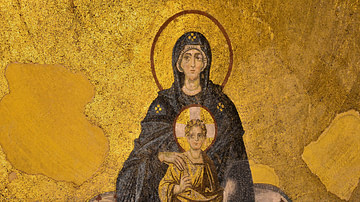
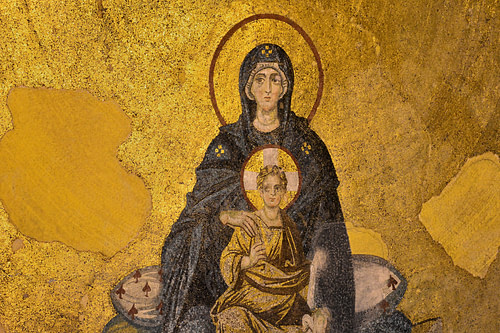
Meanwhile, in the eastern part of the Roman Empire, what became known as the Byzantine Empire (330-1453 CE), and especially at Antioch, the 4th century CE saw the spread of mosaics which used two-dimensional and repeated motifs to create a 'carpet' effect, a style which would heavily influence later Christian churches and Jewish synagogues. Byzantine Christian churches widely employed wall mosaics from the 4th century CE, especially on the curved upper portions of walls and vault ceilings. A common characteristic is the use of gold tiles which create a glittering setting for portraits of Jesus Christ, the Virgin Mary, saints, and emperors. The Hagia Sophia in Constantinople (Istanbul) contains the most celebrated examples of such mosaics while one of the most unusually striking portraits in the medium is that of Jesus Christ in the dome of Daphni in Greece. Produced around 1100 CE, it shows Christ with a rather fierce expression which is in contrast to the usual expressionless representation. Worthy of special mention, too, is the church of San Vitale in Ravenna, Italy. There, two shimmering gold panels, dating to the 540s CE, show Emperor Justinian I (r. 527-565 CE) and his consort Empress Theodora with their respective entourages.
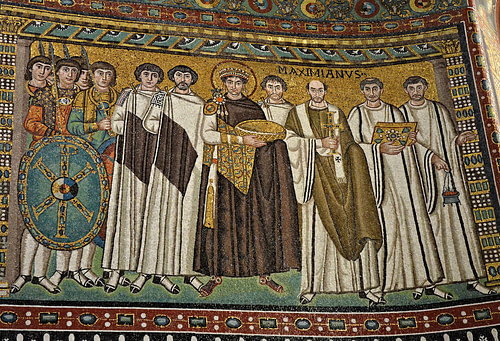
Byzantine mosaic artists became so famous for their work that the Arab Umayyad Caliphate (661-750 CE) employed them to decorate the Dome of the Rock in Jerusalem and the Great Mosque of Damascus. Finally, just as in painting, in the 13th and 14th century CE, the subjects in mosaics become more natural, expressive, and individualised. Excellent examples of this style can be seen in the mosaics of the Church of the Saviour, Chora, Constantinople.
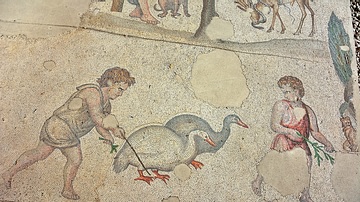
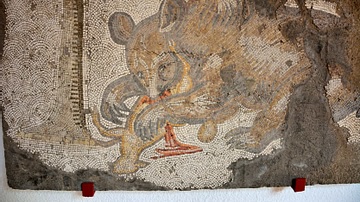
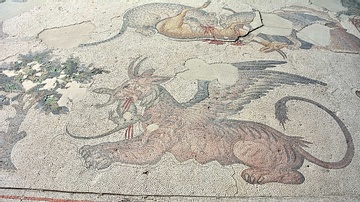
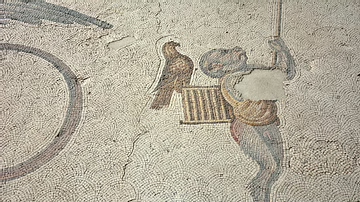
Finally, some of the finest surviving Byzantine mosaics come from the Great Palace of Constantinople, in use from 330 CE to 1453 CE. Not very much remain of the buildings but many floor mosaics do, and these depict all manner of scenes from Byzantine daily life, especially scenes of nature, hunting, and children playing games. These mosaics mostly date to the 6th century CE, and interestingly they often continue to employ pagan imagery alongside Christian subjects. They can be seen today in the Great Palace Mosaic Museum of Istanbul. As the Byzantine Empire reached its end, the much cheaper alternative of fresco painting overtook mosaics as the choice method to decorate public and private buildings.
Mesoamerican Mosaics
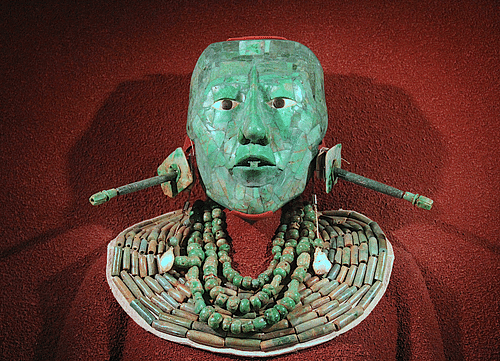
On the other side of the world, the Puuk architecture of the Classic Maya (250-950 CE) often employs stone mosaic decorations and designs, particularly on the upper facades of buildings. A fine example is the Nunnery Quadrangle building of Uxmal, built in the 9th century CE, which has facade mosaics in stone depicting miniature people and houses. A similar technique was used by other Mesoamerican cultures, notably the Zapotec civilization (500 BCE - 900 CE) at Mitla. Another fine example of Maya mosaic work on a smaller scale, this time using irregular pieces of jade, is the mask of the Palenque king Kinich Janaab Pacal (r. 615-683 CE). The mask was laid on the king's face when he was buried within the Temple of Inscriptions at Palenque and now resides in the National Museum of Anthropology, Mexico City.
In post-Classical Mexico and Yucatan turquoise, one of the most esteemed materials in Mesoamerica, was used as mosaic tiles by several Mesoamerican cultures. Both the Toltec and Mixtec used them in the first quarter of the second millennium CE, but the shape of tesserae differs being polygonal and flat in the former and more like pebbles in the artworks of the latter. Such items as pectorals, knives, shields, masks, and skulls were covered in turquoise with details picked out in red spondylus shell, white conch shell, mother of pearl, black obsidian or polished pyrite. The tesserae were typically attached to a cedarwood backing using pine resin as glue.
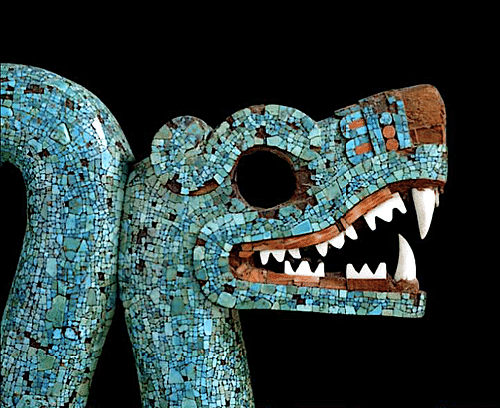
The Aztec civilization (c. 1345-1521 CE) had a particular love of turquoise mosaic designs, and two of the most famous artworks of all of Mesoamerica employ it. The first is the mask of Xiuhtecuhtli, the Aztec god of fire (created 1400-1521 CE) which not only has precisely cut pieces to give such parts as the nose and mouth contours but also uses different shades of turquoise to enhance the three-dimensional effect. The second great example is the pectoral in the form of a double-headed serpent. Made in the 15-16th century CE, the animal is covered in hundreds of regular and irregular turquoise tesserae. Both of these pieces are now in the British Museum, London.