Edit Definition
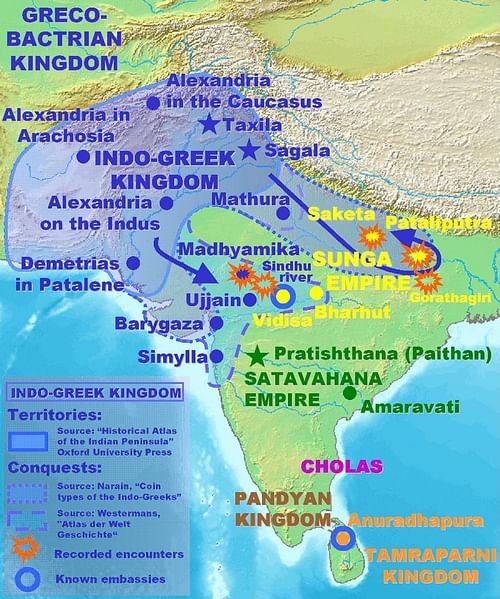
The first Indo-Greek kingdom appeared circa 190 BC may when the Greco-Bactrian king or (general for his father) Demetrios was busy in India, when his Indian possessions were divided between several kings, probably firstly in order to better govern them but then due to civil war. The term “Indo-Greek” is generally used because these kingdoms were almost always separated from Bactria and thus differed politically from the Greco-Bactrian kingdom. These kingdoms, in which there were already some Greek settlers called Yonas, took more and more Indian characteristics, becoming truly unique political entities with a mix of Greek and Indian culture, at least for the ruling elites.
Indo-Greek kingdoms timeline is very approximate. Between 190 BC and circa 165 BC, Greek possessions in India were divided between several Euthydemid kings which fought among themselves and their Greco-Bactrian neighbors. These kingdoms extended to Western Punjab and had Indians of Sunga dynasty as neighbors. Circa 165 BC the Greco-Bactrian rebel Eucratides invaded the Indo-Greek kingdoms and, defeating Antimachos II, succeeded to take control of most of the Indo-Greek possessions. Unluckily for him, Menander, his last Euthydemid enemy, pushed him back to Bactria circa 155 BC. Thus the Indo-Greek kingdoms were safely under Euthydemid rule for the next 25 years. In this time Menander extended Greek rule as far as Paliputra (today Patna, in northeast India), but fell in a civil war.
However circa 130 BC, the Euthydemid kings were chased away from Bactria by the Yuezhei and settled down in strength in the Indo-Greek territories. From 130 BC to 80 BC, numerous Indo-Greek kings ruled in India, often in little kingdoms, fighting among each other, while Arachosia was lost to the Sakas. Some kings seem to have nearly succeeded to reunite these areas, like Eucratids Philoxenos and Diomedes, but finally failed. One Euthydemid queen, Agathokleia, made a strong regency for her son Strato in this time too. Yet at the turn of the century the Indo-Greek regions were highly fragmented.
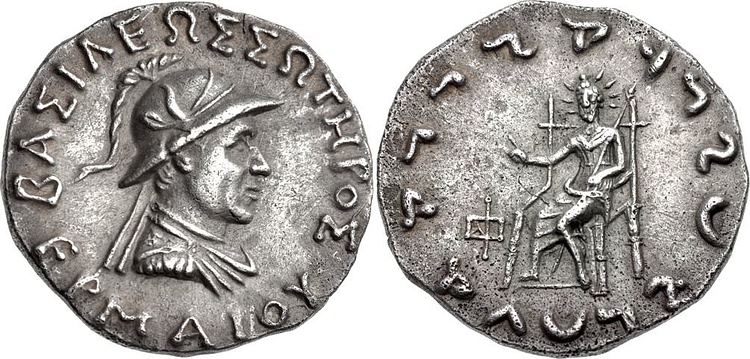
The disruptive element came circa 80 BC, when the Saka king Maues attacked the Indo-Greek kingdoms. He won against several Euthydemid and Eucratid kings, taking the Paropamisadae, Gandhara and Western Punjab. Against this invader, the both dynasties forged an alliance under the rule of Amyntas, whose resistance in eastern Punjab saved Indo-Greek kingdoms, and by circa 65 BC the Indo-Greek kings regained their kingdoms and their rivalry. The final moments of Indo-Greek history are written in civil wars once more, with the quick loss of all the Western possessions to the Indo-Saka kings. The last Indo-Greek king Strato II ended his rule circa 10 BC, vanquished by the Indo-Saka king Rajuvula.
The Indo-Greek kings and kingdoms are absent in the Greek imagination, because of the estrangement from the Greek world and the cut of political links due to Parthian and Sakas presence between India and Greece. However these kingdoms appear to have strongly influenced their Indian subject and Indian or nomad neighbors, as the nature of Indian art from the period, as well as the mention of the Yonas in Asoka's edicts suggest.
Definition
The first Indo-Greek kingdom appeared circa 190 BC may when the Greco-Bactrian king or (general for his father) Demetrios was busy in India, when his Indian possessions were divided between several kings, probably firstly in order to better govern them but then due to civil war. The term “Indo-Greek” is generally used because these kingdoms were almost always separated from Bactria and thus differed politically from the Greco-Bactrian kingdom. These kingdoms, in which there were already some Greek settlers called Yonas, took more and more Indian characteristics, becoming truly unique political entities with a mix of Greek and Indian culture, at least for the ruling elites.Indo-Greek kingdoms timeline is very approximate. Between 190 BC and circa 165 BC, Greek possessions in India were divided between several Euthydemid kings which fought among themselves and their Greco-Bactrian neighbors. These kingdoms extended to Western Punjab and had Indians of Sunga dynasty as neighbors. Circa 165 BC the Greco-Bactrian rebel Eucratides invaded the Indo-Greek kingdoms and, defeating Antimachos II, succeeded to take control of most of the Indo-Greek possessions. Unluckily for him, Menander, his last Euthydemid enemy, pushed him back to Bactria circa 155 BC. Thus the Indo-Greek kingdoms were safely under Euthydemid rule for the next 25 years. In this time Menander extended Greek rule as far as Paliputra (today Patna, in northeast India), but fell in a civil war.
However circa 130 BC, the Euthydemid kings were chased away from Bactria by the Yuezhei and settled down in strength in the Indo-Greek territories. From 130 BC to 80 BC, numerous Indo-Greek kings ruled in India, often in little kingdoms, fighting among each other, while Arachosia was lost to the Sakas. Some kings seem to have nearly succeeded to reunite these areas, like Eucratids Philoxenos and Diomedes, but finally failed. One Euthydemid queen, Agathokleia, made a strong regency for her son Strato in this time too. Yet at the turn of the century the Indo-Greek regions were highly fragmented.
The disruptive element came circa 80 BC, when the Saka king Maues attacked the Indo-Greek kingdoms. He won against several Euthydemid and Eucratid kings, taking the Paropamisadae, Gandhara and Western Punjab. Against this invader, the both dynasties forged an alliance under the rule of Amyntas, whose resistance in eastern Punjab saved Indo-Greek kingdoms, and by circa 65 BC the Indo-Greek kings regained their kingdoms and their rivalry. The final moments of Indo-Greek history are written in civil wars once more, with the quick loss of all the Western possessions to the Indo-Saka kings. The last Indo-Greek king Strato II ended his rule circa 10 BC, vanquished by the Indo-Saka king Rajuvula.
The Indo-Greek kings and kingdoms are absent in the Greek imagination, because of the estrangement from the Greek world and the cut of political links due to Parthian and Sakas presence between India and Greece. However these kingdoms appear to have strongly influenced their Indian subject and Indian or nomad neighbors, as the nature of Indian art from the period, as well as the mention of the Yonas in Asoka's edicts suggest.
Donate and help us!
We're a non-profit organisation and we need your help! This website costs money and research material isn't cheap either. We are supported only by our donors. Please consider donating; even small amounts help. Thank you!
Bibliography
Peer Review
Are you qualified to peer review ancient history information? Apply now and help provide quality ancient history information on the web!
Articles
Article
Cyrus the Great (558-530 BC) built the first universal empire, stretching from Greece to the Indus River. This was the famous Achaemenid Dynasty of Persia. An inscription at Naqsh-i-Rustam, the tomb of his able successor Darius I (521-486 BC), near Persepolis, records Gadara (Gandhara) along with Hindush (Hindus, Sindh) in the long list of satrapies... [continue reading]
Article
The rarity of the appearance of Greco-Bactrian and Indo-Greek kingdoms in ancient literature is one of the reasons why those states are so little-known today. Indo-Greek literature did exist, but none has been found that speaks about the Greco-Bactrian and Indo-Greek states. Classical authors tell us very little about Indo-Greek kingdoms, as they were... [continue reading]
Article
Warning: See the definitions of Greco-Bactrian and Indo-Greek Kingdoms before reading this article, otherwise the following lines could give you serious headaches! A lack of information is a common problem for historians of the Greco-Bactrian and Indo-Greek kingdoms, due to the almost-inexistence of written accounts about them. The fact that the modern... [continue reading]
Interesting Pages
You might also find the following pages interesting...
Comments
|
|
Please log in or register to post comments. Sadly this is necessary to prevent comment spam. Alternatively, you can use the comments widget below.
Add Event
Timeline
Visual Timeline-
c. 200 BCE - c. 185 BCEDemetrios is general for his father and then becomes king, greatly extending the kingdom in India.
-
c. 190 BCEFirst appearance of multiple Euthydemid kings at the same time. Beginning of the Indo-Greek kingdoms.
-
171 BCEIn odrer to show the break of dynasty, Eucratides begin a new Yona (or Greek) era.
-
c. 165 BCE
-
c. 155 BCE
-
c. 130 BCEEucratids flee from Bactria to India. Rivalry between Eucratids and Euthydemids takes place in the Indo-Greek kingdoms.
-
c. 110 BCEArachosia lost to the first Indo-Saka kingdom.
-
c. 80 BCE
-
c. 70 BCE - c. 10 BCELast Indo-Greek kings, probably Euthydemid ones.
-
c. 55 BCE - c. 50 BCEGandhara and Western Punjab lost to Indo-Saka kings.


Follow us on Google Plus
Follow us on Facebook
Join us on LinkedInAncient History Group
Ancient History Encyclopedia Profile
Tweet
Follow us on TwitterWe're a non-profit company, and we need your help. For as little as 2 $/€/£ you can help us provide the best free ancient history information on the web. Thank you!
Donate now!