Greco-Bactria

Edit Definition

Definition

The Greco-Bactrian kingdom refers to several dynasties and probably kingdoms of Greco-Macedonian monarchs who ruled over Bactria from 250 to 130 BC.

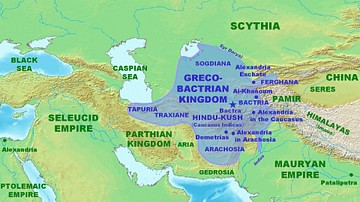
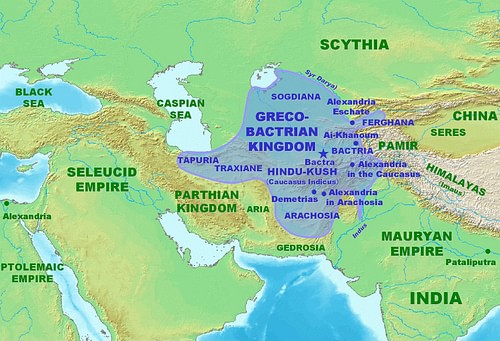
The Greco-Bactrian kingdom appeared in 250 BC, when the satrap Diodotos (or Theodotus in Latin) rebelled against his Seleucid ruler, Antiochos II, knowing that Antiochus was occupied struggling against the Ptolemies in the west. At first Diodotos and his son Diodotos II conquered many territories southward in Ariana, restricting their conquests to Bactria. However around 230 BC, a local ruler named Euthydemos, maybe linked to the Seleucids, overthrew the Diodotids and created his own dynasty, extending his territory northward into Sogdiana and Ferghana. In 210 BC, the Seleucid Antiochos III fought victoriously against Euthydemos, forcing him to retreat, which led to a three-year siege of Bactra. This endless siege and the threat of the northern nomads forced Antiochos III to negotiate: He recognized Euthydemos as king and gave him one of his daughters in exchange of supplies and war elephants.

Having the west front secured, the Greco-Bactrian kings waged war against their eastward neighbors, taking advantage of the decline of the Mauryan dynasty. In less than 20 years, under Demetrios and his descendants, they took the Paropamisadaes, Arachosia, Gandhara and Western Punjab. At the same time the central power was divided between several kings which seemed not be always in good terms. Some of them ruled only eastward of the Hindukush, being the first Indo-Greek kings.

In 171 BC Eucratides, who may also have been linked to the Seleucids, overthrew the Greco-Bactrian king and waged war against the Indo-Greek kings. He was successful at first until an Euthydemid called Menander forced him to retreat west of the Hindu-Kush in Bactria. This marked the beginning of the rivalry between the Euthydemid and the Eucratid dynasties, which lasted for a long time. This rivalry weakened the Greco-Bactrian kingdom: Sogdiana was soon lost, and  Eucratides was forced to abandon western Bactria to Parthian kings. In 145 BC, Eucratides was murdered by his own son, which led a period of politic instability resulting in the overthrow of the last Indo-Greek king, Heliokles, in 130 BC by the Yuezhei nomads.

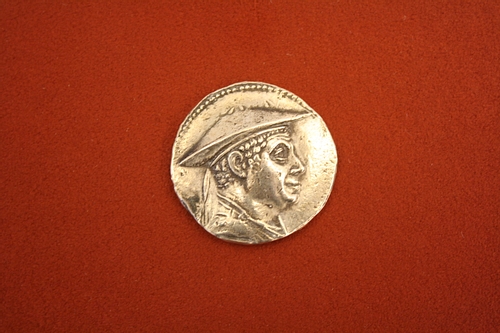
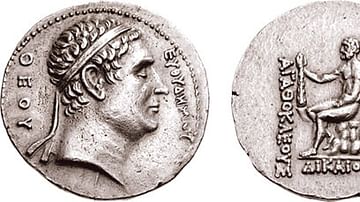
The Greco-Bactrian kingdom had a unique place in the Greek imagination, being a Hellenistic kingdom at the border of the known world. This kingdom had frequent contacts with Indian and nomad neighbors, and possibly also the Chinese, which is evident in the spread of their goods and coins. The Greco-Bactrian art was known to be one of the finest at this time, as the statues found at Ostobora (modern Aï Khanoum) and Bactra attest, and their coins were of particularly high quality. This originality was not lost with the fall of the last Greco-Bactrian king, because some continuations of Greco-Bactrian art is evident in their Yuezhei and Koushan successors.

Written by , published on under the following license: Creative Commons: Attribution-NonCommercial-ShareAlike. This license lets others remix, tweak, and build upon this content non-commercially, as long as they credit the author and license their new creations under the identical terms.

Donate and help us!

We're a non-profit organisation and we need your help! This website costs money and research material isn't cheap either. We are supported only by our donors. Please consider donating; even small amounts help. Thank you!

Peer Review

Are you qualified to peer review ancient history information? Apply now and help provide quality ancient history information on the web!

Articles

Article
Ai Khanum (also spelled Ai-Khanoum or Ay-Khanum, lit. “Lady Moon” in Uzbek), was founded in the 4th century BC, following the conquests of Alexander the Great and was one of the primary cities of the Greco-Bactrian kingdom. The site is located in the northern part of modern Afghanistan, in a little plain between the Amou-Darya and the Kokcha... [continue reading]
Article
Cyrus the Great (558-530 BC) built the first universal empire, stretching from Greece to the Indus River. This was the famous Achaemenid Dynasty of Persia. An inscription at Naqsh-i-Rustam, the tomb of his able successor Darius I (521-486 BC), near Persepolis, records Gadara (Gandhara) along with Hindush (Hindus, Sindh) in the long list of satrapies... [continue reading]
Article
The rarity of the appearance of Greco-Bactrian and Indo-Greek kingdoms in ancient literature is one of the reasons why those states are so little-known today. Indo-Greek literature did exist, but none has been found that speaks about the Greco-Bactrian and Indo-Greek states. Classical authors tell us very little about Indo-Greek kingdoms, as they were... [continue reading]
Article
Warning: See the definitions of Greco-Bactrian and Indo-Greek Kingdoms before reading this article, otherwise the following lines could give you serious headaches! A lack of information is a common problem for historians of the Greco-Bactrian and Indo-Greek kingdoms, due to the almost-inexistence of written accounts about them. The fact that the modern... [continue reading]
Add Illustration

Illustrations

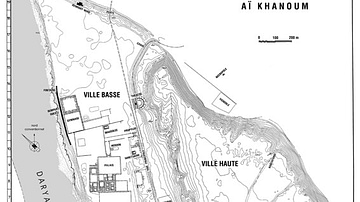
Map of the Greco-Bactrian Kingdom Commemorative coin of Euthydemos from Agathokles of Bactria Greco-Bactrian kingdom circa 230-200 BC Greek and Aramaic inscriptions by king Ashoka Plan of Ai Khanum Cybele Plate

Interesting Pages

You might also find the following pages interesting...

Related Posts Plugin for WordPress, Blogger...
Recommend Book

Greco-Bactria Books


Comments

Please log in or register to post comments. Sadly this is necessary to prevent comment spam. Alternatively, you can use the comments widget below.

  • Dr. Ranajit Pal wrote on 04 October 2011 at 02:15:

    I have written in a paper published in the journal Scholia (vol. 15) that Diodotus-I was the great Asoka, but sadly this is not taken into account in this article. The paper is also available at
    http://ranajitpal-jesus-from-asia-minor.blogspot.com/

Advertisement

Why ads? / Advertise Here
Add Event

Timeline

Visual Timeline
  • 250 BCE
    Former satrap Diodotos rebels against Seleucid king Antiochos I, creating the Greco-Bactrian kingdom.
  • c. 230 BCE
    Diodotos II is overthrown by Euthydemos. Beginning of the Euthydemid dynasty.
  • 208 BCE
    Seleucid king Antiochos III wins the battle of the Arius river against Euthydemos.
  • 208 BCE - 206 BCE
    Siege of Bactra by Antiochos III.
  • 206 BCE
    Recognition of the Greco-Bactrian kingdom and Euthydemid dynasty by Antiochos III.
  • c. 200 BCE
    Beginning of the Greco-Bactrian conquests in India.
  • c. 190 BCE
    First appearance of multiple Euthydemid kings at the same time. Beginning of the Indo-Greek kingdoms.
  • 186 BCE
    Demetrios wins a decisive battle in Gandhara, beginning the Yona (or Greek era) in India.
  • 171 BCE
    In odrer to show the break of dynasty, Eucratides begin a new Yona (or Greek) era.
  • c. 171 BCE
    Eucratides begins his uprising against Greco-Bactrian king Demetrios II.
  • c. 155 BCE
    The Euthydemid Menander succeeds to push back the Eucratids westward of the Hindu-Kush.
  • 145 BCE
    Murder of Eucratides by his son. Weakening of the Greco-Bactrian kingdom.
  • c. 130 BCE
    The Yuezhei take control of Bactria.