Edit Definition
Definition
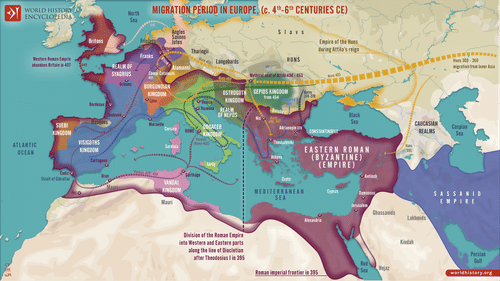
The Migration Period, also called the Barbarian Invasions or German: Völkerwanderung (wandering of the peoples), was a period of human migration that occurred roughly between AD 300 to 700 in Europe, marking the transition from Late Antiquity to the Early Middle Ages. These movements were catalyzed by profound changes within both the Roman Empire and the so-called 'barbarian frontier'. Migrating peoples during this period included the Huns, Goths, Vandals, Bulgars, Alans, Suebi, Frisians, and Franks, among other Germanic and Slavic tribes.
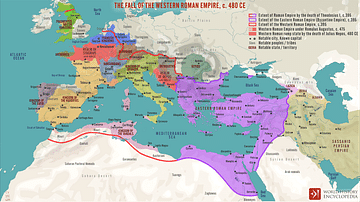
The migration movement may be divided into two phases: The first phase, between AD 300 and 500, put Germanic peoples in control of most areas of the former Western Roman Empire. The first to formally enter Roman territory — as refugees from the Huns — were the Visigoths in 376. Tolerated by the Romans on condition that they defend the Danube frontier, they rebelled, eventually invading Italy and sacking Rome itself in 410, before settling in Iberia and founding a kingdom there that endured 300 years. They were followed into Roman territory by the Ostrogoths led by Theodoric the Great, who settled in Italy itself.
In Gaul, the Franks, a fusion of western Germanic tribes whose leaders had been strongly aligned with Rome, entered Roman lands more gradually and peacefully during the 5th century, and were generally accepted as rulers by the Roman-Gaulish population. Fending off challenges from the Allemanni, Burgundians and Visigoths, the Frankish kingdom became the nucleus of the future states of France and Germany. Meanwhile, Roman Britain was more slowly invaded and settled by Angles and Saxons.
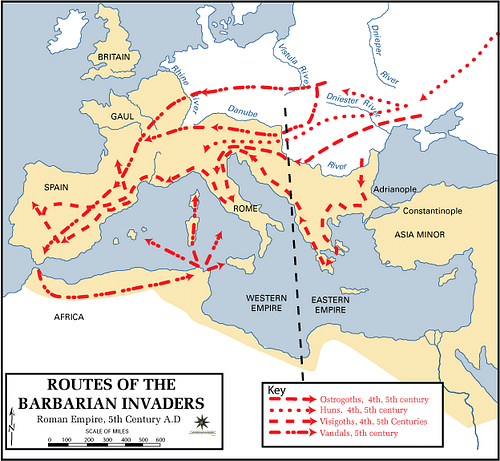
The second phase, between AD 500 and 700, saw Slavic tribes settling in Central and Eastern Europe, particularly in eastern Magna Germania, and gradually making it predominantly Slavic. The Bulgars, a now-Slavicized people possibly of Turkic origin who had been present in far Eastern Europe since the 2nd century, conquered the eastern Balkan territory of the Byzantine Empire in the 7th century. The Lombards, a Germanic people, settled northern Italy in the region now known as Lombardy.
Migrations of peoples, although not strictly part of the 'Migration Age', continued beyond AD 1000, marked by Viking, Magyar, Moorish, Turkic and Mongol invasions, and these also had significant effects, especially in Central and Eastern Europe.
The migration movement may be divided into two phases: The first phase, between AD 300 and 500, put Germanic peoples in control of most areas of the former Western Roman Empire. The first to formally enter Roman territory — as refugees from the Huns — were the Visigoths in 376. Tolerated by the Romans on condition that they defend the Danube frontier, they rebelled, eventually invading Italy and sacking Rome itself in 410, before settling in Iberia and founding a kingdom there that endured 300 years. They were followed into Roman territory by the Ostrogoths led by Theodoric the Great, who settled in Italy itself.
In Gaul, the Franks, a fusion of western Germanic tribes whose leaders had been strongly aligned with Rome, entered Roman lands more gradually and peacefully during the 5th century, and were generally accepted as rulers by the Roman-Gaulish population. Fending off challenges from the Allemanni, Burgundians and Visigoths, the Frankish kingdom became the nucleus of the future states of France and Germany. Meanwhile, Roman Britain was more slowly invaded and settled by Angles and Saxons.

The second phase, between AD 500 and 700, saw Slavic tribes settling in Central and Eastern Europe, particularly in eastern Magna Germania, and gradually making it predominantly Slavic. The Bulgars, a now-Slavicized people possibly of Turkic origin who had been present in far Eastern Europe since the 2nd century, conquered the eastern Balkan territory of the Byzantine Empire in the 7th century. The Lombards, a Germanic people, settled northern Italy in the region now known as Lombardy.
Migrations of peoples, although not strictly part of the 'Migration Age', continued beyond AD 1000, marked by Viking, Magyar, Moorish, Turkic and Mongol invasions, and these also had significant effects, especially in Central and Eastern Europe.
Donate and help us!
We're a non-profit organisation and we need your help! This website costs money and research material isn't cheap either. We are supported only by our donors. Please consider donating; even small amounts help. Thank you!
Bibliography
Peer Review
Are you qualified to peer review ancient history information? Apply now and help provide quality ancient history information on the web!
Articles
Interesting Pages
You might also find the following pages interesting...
Warning: Invalid argument supplied for foreach() in /var/sites/a/ancient.eu.com/public_html/include/template.php on line 432
Recommend Book
Migration Age Books
-

Oxford University Press, USA (24 April 1986)Price: $42.52 -

Oxford University Press, USA (28 August 1986)Price: $61.13 -

Bedford/St. Martin's (22 October 2007)Currently unavailable -

Oxford University Press, USA (29 November 1999)Price: $54.39 -

Collins Reference (31 March 1993)Price: $17.06
Comments
|
|
Please log in or register to post comments. Sadly this is necessary to prevent comment spam. Alternatively, you can use the comments widget below.
Add Event
Timeline
Visual Timeline-
167 CEMarcomanni sack Aquileia.
-
257 CE - 263 CEThe Goths raid Greece.
-
300 CE - 700 CEMigration Age in Europe.
-
372 CEHuns conquer the Ostrogoths.
-
376 CEThe Goths cross the Danube.
-
378 CEThe Goths defeat Emperor Valens is near Adrianople.
-
406 CEVandals, Suevi, and Alans invade Gaul.
-
418 CEVisigoths settle in Aquitaine.
-
429 CEVandals cross Spain to the Maghreb.
-
450 CEAngels and Saxons settle Britain.
-
451 CEAetius defeats Attila of the Huns at the Catalaunian Fields, together with Rome’s allies.
-
455 CEVandals sack Rome.
-
462 CEVisigoths expand into Spain.
-
489 CE - 493 CE
-
503 CEClovis converts to Christianity.
-
507 CEClovis defeats the Visigoths and drives them into the Iberian peninsula.
-
533 CE - 534 CE
-
535 CE - 554 CE
-
568 CE - 582 CELombards invade northern Italy.

Follow us on Google Plus
Follow us on Facebook
Join us on LinkedInAncient History Group
Ancient History Encyclopedia Profile
Tweet
Follow us on TwitterWe're a non-profit company, and we need your help. For as little as 2 $/€/£ you can help us provide the best free ancient history information on the web. Thank you!
Donate now!